Storytelling Creates the World, by Doug Dalglish

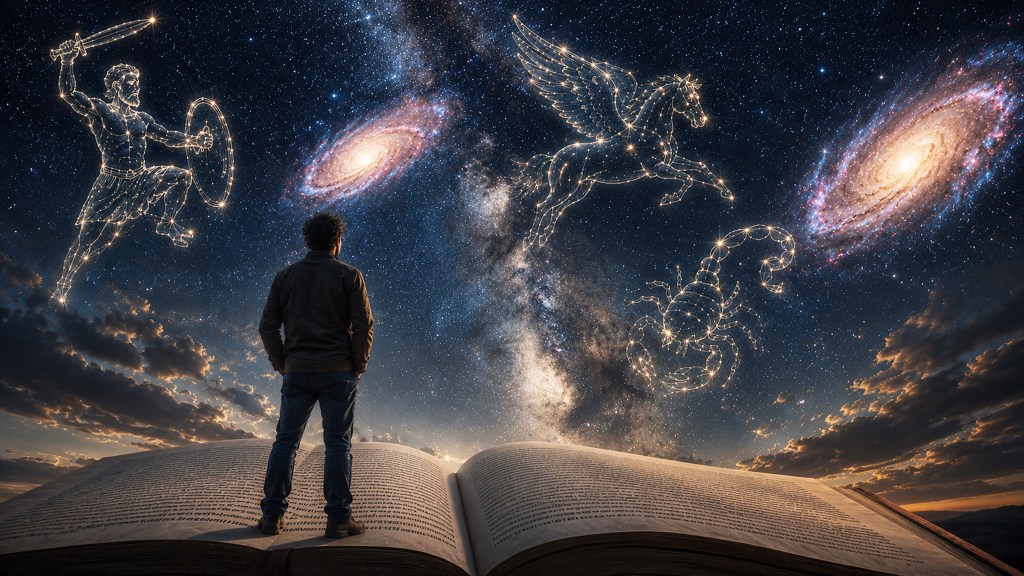
I believe what we call reality is just a bunch of stories we tell ourselves. There are objectively real physical objects out there in the universe. But if we see the lights in the night sky and think of the adventures of Greek gods we are living in a very different reality than if we see those same lights and think of planets revolving around suns as part of a galaxy of billions of suns.

In the same way, lots of real people have lived over the course of history and they did a lot of different things. But the way we organize our understanding of people and events creates the world as we know it. Stories are how we organize the facts of the world around us.

This is why what we teach kids in history classes is always controversial. The details of history might be objective, but how it matters how we choose to arrange those details and interpret their meaning. In the U.S., are we the descendants of brave pioneers who came to a new continent to create a new and better society? Yes. Are we also the descendants of people who couldn’t or wouldn’t do the work of creating a new society on their own and decided to enslave other people to do the work for them? That is also true. When we have the courage to tell both sides of this story we begin to realize that humanity, in every generation, is capable of great good and great evil. If we favor only one part of the story we impoverish our understanding of ourselves.

As it turns out, none of my ancestors did any of those things. All of my ancestors arrived in the U. S. in the twentieth century. But as a person raised in the U.S., the stories of the events of this land have become my history. They are the reality I adopted while listening to the stories told in American history classes.

We have always needed and will always need competent storytellers in our lives. Every child loves stories. Every adult reads books or watches movies or TV or listens to the stories politicians tell us. We are hungry for stories. We understand the world around us based on the stories we’ve been nourished by over the course of our lives. These stories are always biased. All of them advocate for a different version of reality.

As I writer, I feel compelled to tell stories as I assert my view of reality. Throughout my life I have loved learning new stories, both fact and fiction. I’ve loved watching characters in those stories develop and I’ve loved experiencing how a plot twists and resolves. I’ve always wanted to advocate for my own version of reality through the telling of stories.

The worlds I create are always worlds I believe in. They are good and bad in the same way I see the “real” world to be. They are as complicated and inscrutable as the real world. People in my stories are as heroic and flawed as real people. At least, that is my goal.

I create worlds and characters I enjoy spending time with. Writing takes vast amounts of time. If I’m going to spend that much time somewhere, I want it to be a place where I can learn and grow, where I can see the world in a new way, and also where I can sometimes just relax and enjoy myself.

About the author: Doug Dalglish has been an electrical engineer, a US Marine, and a Presbyterian pastor. He is also an avid naturalist. He brings all of these worlds together in his writings. He and his wife raised their family in the rugged hills three hours east of Ciudad Acuña, Mexico. It is this wild land that sparked many of his most imaginative stories. From near-future cautionary tales to Stone Age science fiction, his most improbable stories rise from the strangeness of the natural world.
SO, YOU WANT TO BE A WRITER? – by David Clear

Mrs. Blythe’s 2nd grade class, 1962: The Magical Letters on the Wall

They were posted above the blackboard. All 26 of them, upper and lower case, neatly drawn on lined paper and large enough to see from a distance. They were designed to be a chore to learn and to copy, but to my seven-year-old eyes they seemed to radiate a light, an energy of some sort, different from everything else in the room.

When I reflect on this memory, one truth emerges—I was in love with the alphabet, with the words it could create, and with the worlds those words could fashion.

My mother bought me the World Book Encyclopedia while I was still in my single digits. I fell further in love with words, ideas, and stories. I am most thankful to my mother for encouraging me to learn how to use a typewriter and buying me one of my own. After the slow and cumbersome world of cursive writing, it was like being catapulted to the 24th century of Star Trek.

And then, when I was able to upgrade to an electric typewriter, I was officially lost forever in the So You Want to Be a Writer nebula.

I started my first novel length story at 14 years old, a mishmash of romance, adventure, Beatle’s music, and psychic phenomenon. I experimented with sci-fi and espionage scenarios but burned up the most typewriter ribbon ink and paper on classic adolescent angst journals.

I was a scribbling prospector wandering the bookstores by day and thinking, by night, that golden nuggets were rolling off my electric typewriter. Just a matter of time before the world found out about them.

“Writers are only successful after they’re dead,” my dad told me. I disagreed, of course. After all, I saw writers like Gore Vidal, Norman Mailer, Richard Bach, Erica Jong, Stephen King, and others being interviewed on nighttime talk shows, an obvious sign of success.

Nevertheless, it didn’t take me long to realize that the arduously slow task (by 21st century standards) of sending in stories on a typewritten piece of paper with a self-addressed stamped envelope, only to receive a rejection, wasn’t going to earn me any money to pursue it as a career.

To write, perchance to dream of making money at it; ay, there’s the rub.

It would be interesting (and likely depressing) if the ratio of wannabe paid writers to actual paid writers could be calculated. And when I say paid, I don’t mean utilitarian authors who write for newspapers, ad copy, or technical journals. I mean bestsellers like Jonathan Livingston Seagull, Harry Potter, the DaVinci Code, The Celestine Prophecy, or The Andromeda Strain.

Herman Melville had explosive success with his first two books, Typee and Omoo. But then, Moby Dick. The readers of his time didn’t get it. It sold only about 3700 copies in his lifetime. But the fact that it stands today as a masterpiece of American literature redeems Melville’s inner drive and vision to create something that went beyond the commercial market and challenged the consciousness of the reader. Melville, like F. Scott Fitzgerald and others, died well before their work achieved iconic status. I would suspect by then they were dispassionate about becoming earthly literary legends and were on to working on other, more universal projects.

I think the most important lesson I’ve learned about writing over sixty years is that the passion for it and practice of it is, first and foremost, its own ultimate and eternal reward. At age 92, the famous cellist Pablo Casals was asked why he still practiced. “Because I think I’m making progress.”

Being an author may seem to have greater cachet than being an HVAC repairman. Having lived in the south for many years, I can tell you honestly that the HVAC repairmen were equally, if not more, essential to my well-being than A Farewell to Arms. My interaction with the HVAC repairman is as valid and important in its own way as a reader’s interaction with what I have written. The difference, of course, is utilitarian versus personal. By sharing my inner worlds through my words, I am becoming more open to another human being than were I just the repairman who says, “well, the system is out of freon.”

But people connect and share with each other in many ways all the time. In that sense, writing is just another aspect of the nature and rules of human life: there’s much to learn, and doing it well takes regular study and practice.

At this very moment, millions of people are, like me, hovering over keyboards trying to channel what is percolating within them. Many others are “just” doing their jobs, raising their children, exercising, meditating, or traveling. All of them are drafting their stories by being. Whether in the form of a New York Times bestseller, or in a child’s eyes, I believe everyone’s story is heard, read, and felt.

So, paraphrasing Twain, it would seem the difference between being a writer and being a highly paid successful writer is the difference between lightning and a lightning bug. And who’s to say which is more rewarding?

Kurt Vonnegut wrote the following words in a letter dated November 5, 2006, addressed to students at Xavier High School in New York City. He had been approached by five students whose assignment was to write to their favorite authors. He was the only one to respond. I think his words capture the gist of what I’m saying.

“Practice any art, music, singing, dancing, acting, drawing, painting, sculpting, poetry, fiction, essays, reportage, no matter how well or badly, not to get money and fame, but to experience becoming, to find out what’s inside you, to make your soul grow” 

About the author: David Clear’s novel, Dreaming at the Speed of Sound, is available at this link. He has also had the following stories published by Story Sanctum: Cresting WaveThus Spake Alan, and The Overdue Library Book. David’s collection of short stories entitled The Role of a Lifetime: Stories of Reincarnation in the Theater of the Soul has just been released by Second Shore Publishing. Here is a downloadable PDF copy.

Pole to Pole with Age Old, Liberating Truth

I’ve been watching Pole to Pole, a National Geographic series hosted by Will Smith. His objective intrigued me: “to travel across all seven continents, to explore the world’s most extreme environments, seeking answers to life’s important questions by stepping into the unknown.”

Episode Four finds him trekking to the Himalayan nation of Bhutan. He was there to explore the secret of happiness, famously enshrined by the Bhutanese in their concept of Gross National Happiness. You got that right. GNH, not GNP.

In one scene, Smith sits with a Buddhist monk who offers a disarmingly direct message. If we contemplate death regularly, not as a morbid obsession but as a truth we refuse to look away from, it sharpens our awareness of being alive. It makes the ordinary radiant. It turns the fleeting resource of time into something sacred.

We’ve always known this, haven’t we? It’s one of humanity’s oldest lessons, hiding in plain sight. The fact that we will die is not a curse. It is the condition that gives life its urgency and texture.

And yet, think of how much effort we’ve poured into pretending otherwise.

The pharaohs of ancient Egypt didn’t just accept mortality; they aimed to defeat it. They constructed pyramids, had their bodies mummified, and buried themselves with treasures, all to ensure that their power continued in the afterlife.

Chinese Emperor Qin’s Terracotta Army has stood for two millennia in silent formation beneath the earth. Thousands of life-sized soldiers created to guard him in the next world. Imagine the slave labor, the resources, and the sheer will it took to bring that vision into being. All of it to satisfy an “afterlife ego.”

History is rife with other examples. Roman Emperors deified themselves, casting their likenesses in marble and bronze as a desperate attempt at permanence. Medieval alchemists searched for the elixir of life, convinced that somewhere in the crucible of chemistry lay a secret that could outwit time. Ponce de Leon searched unsuccessfully for the Fountain of Youth.

Fast forward to our modern world. The demand for cosmetic surgery continues to rise, promising a veneer that masks the inevitable. Companies offer cryogenic freezing, allowing us to gamble on a future where science might reverse the irreversible. Even our language reflects our resistance to embrace death’s reality. We “pass away.” We are “no longer with us.” “Grandma is in heaven with Jesus.”

I get it. It’s profoundly unsettling to think that everything we are—our memories, our relationships, our inner worlds—will simply stop. It’s not just our fear of pain or the unknown. It’s the erasure that unnerves us.

As I watched Smith speak to that Bhutanese monk, it was clear to me. The problem isn’t death itself. It’s the energy we spend trying to outrun it.

So, even though it’s obvious, let’s say it again. Each of us will die.  Not someday in the abstract, but actually. No exception. No workaround.

The art is to make this a portal to liberation. Once we stop buffering ourselves from death, it clears the clutter and exposes what matters. Petty grievances lose their grip. Delayed dreams start to feel urgent. The people we love become more vivid, more necessary, and more present in our lives.

Contemplating death doesn’t shrink life. It enlarges it. It makes our morning coffee taste a little better. It makes the sunlight on a wall feel like a small miracle. It reminds us that the conversation we’ve been putting off might be worth having today. It prompts us to feel grateful, knowing how quickly everything can disappear.

Let the thought of your own finitude sit beside you today. Not as a threat, but as a companion. Let it moisten your appetite for the ordinary yet EXTRAORDINARY fact that you are alive RIGHT NOW.

This is not a morbid discipline. It’s a beginning.