Storytelling Creates the World, by Doug Dalglish

I believe what we call reality is just a bunch of stories we tell ourselves. There are objectively real physical objects out there in the universe. But if we see the lights in the night sky and think of the adventures of Greek gods we are living in a very different reality than if we see those same lights and think of planets revolving around suns as part of a galaxy of billions of suns.

In the same way, lots of real people have lived over the course of history and they did a lot of different things. But the way we organize our understanding of people and events creates the world as we know it. Stories are how we organize the facts of the world around us.

This is why what we teach kids in history classes is always controversial. The details of history might be objective, but how it matters how we choose to arrange those details and interpret their meaning. In the U.S., are we the descendants of brave pioneers who came to a new continent to create a new and better society? Yes. Are we also the descendants of people who couldn’t or wouldn’t do the work of creating a new society on their own and decided to enslave other people to do the work for them? That is also true. When we have the courage to tell both sides of this story we begin to realize that humanity, in every generation, is capable of great good and great evil. If we favor only one part of the story we impoverish our understanding of ourselves.

As it turns out, none of my ancestors did any of those things. All of my ancestors arrived in the U. S. in the twentieth century. But as a person raised in the U.S., the stories of the events of this land have become my history. They are the reality I adopted while listening to the stories told in American history classes.

We have always needed and will always need competent storytellers in our lives. Every child loves stories. Every adult reads books or watches movies or TV or listens to the stories politicians tell us. We are hungry for stories. We understand the world around us based on the stories we’ve been nourished by over the course of our lives. These stories are always biased. All of them advocate for a different version of reality.

As I writer, I feel compelled to tell stories as I assert my view of reality. Throughout my life I have loved learning new stories, both fact and fiction. I’ve loved watching characters in those stories develop and I’ve loved experiencing how a plot twists and resolves. I’ve always wanted to advocate for my own version of reality through the telling of stories.

The worlds I create are always worlds I believe in. They are good and bad in the same way I see the “real” world to be. They are as complicated and inscrutable as the real world. People in my stories are as heroic and flawed as real people. At least, that is my goal.

I create worlds and characters I enjoy spending time with. Writing takes vast amounts of time. If I’m going to spend that much time somewhere, I want it to be a place where I can learn and grow, where I can see the world in a new way, and also where I can sometimes just relax and enjoy myself.

About the author: Doug Dalglish has been an electrical engineer, a US Marine, and a Presbyterian pastor. He is also an avid naturalist. He brings all of these worlds together in his writings. He and his wife raised their family in the rugged hills three hours east of Ciudad Acuña, Mexico. It is this wild land that sparked many of his most imaginative stories. From near-future cautionary tales to Stone Age science fiction, his most improbable stories rise from the strangeness of the natural world.

Writing 101, by Ralph Bland

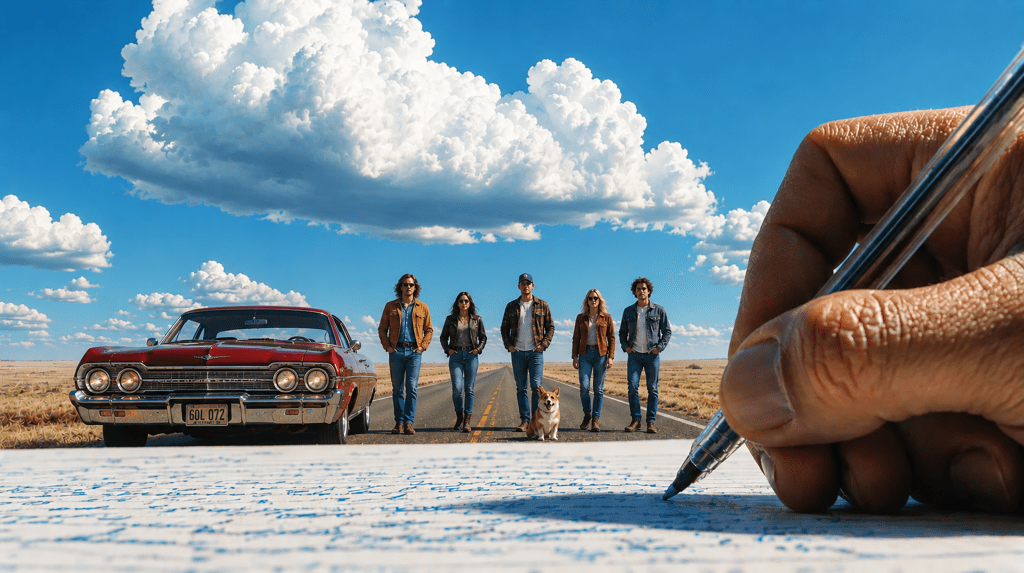
Years ago, when I first began to write seriously, my plan was to always connect Point One to Point Two in some sort of scientific method, hoping to proceed that way toward a happy fulfillment. I envisioned the process being completed in a prearranged way with an outline and notes to help me along, but there always came a moment when I suddenly sat back and said “Whoa!” This was the time when I discovered that my protagonist was acting funny and had stepped outside his planned activities and my mapped-out plot had gone in strange, different directions. All at once my storyline was not anywhere near the place I’d envisioned it to be, and I’d find I didn’t know what kind of book I was writing anymore. What started out as a smooth process now had detours and sinkholes that caused my stories to stop and swerve and run off my planned narrative highway onto the literary shoulder. On those occasions, I found myself having to pause with my plans and ask myself the disconcerting question -what do I do next?

I’ve written a slew of novels at this point in time, so I guess I shouldn’t be surprised anymore when I discover I’m not really in charge of my project anymore. It always seems to be a case of the components of the manuscript stepping up to the fore and announcing they are taking over. I’m forced to throw away my previous conceptions and find a seat in the audience and let the characters and the plot and the style join together as a team and do what needs to be done to move the process along. All the stuff that was originally in my head doesn’t get totally discarded, but is used in this new approach as filler and launching pads for what is being revealed to me each writing session. It’s amazing what characters step to the fore and how the narrative proceeds when I simply get out of the way and let things flow naturally.

This is not to say that once the auto-pilot mode takes over that everything then becomes smooth and peachy. Oh no. There are still moments when the plot or the characters freeze and stumble and lose their way, and that is the time I arise from my desk and go take a walk and let the whole shebang take a breather. I and my stumbling manuscript jointly kick back and stew in our own juices a while. And usually when I return to my desk, there are fresh ideas and new avenues waiting there for me to consider. I simply practice the art of stillness for a time and allow my muse to interact with the world living in my manuscript. I find if I don’t get so anxious and give all the elements time to breathe, the right scenarios soon appear and the wagons get rolling again.

It’s entertaining sometimes to go back and study my old notes and initial outlines after a manuscript has been completed and take notice of how much my plans changed or did a complete about-face or disappeared in their entirety. More times than not, the initial sketchings and the finished product don’t resemble each other much at all, and from what I’ve learned over the years, the end result is generally much better than what my feeble brain conjectured in the first place.

My technique is never going to end up in the Writer’s Holy Grail Handbook on how to create and be successful. All I know is that somewhere along the way I learned how to get out of my own way and trust that the plates and dishes I’d been juggling would eventually find their place in the manuscript without shattering into pieces. Instead of forcing new truths onto the page or inventing narratives that don’t belong, I’ve learned to let the story settle into its own shape and reveal what it’s been trying to say all along. I’ve learned one can spoil the dinner if the broth gets added to and stirred too awfully much.

My process for writing then is to take some time to allow the words to simmer. Take a break and let the planet take a few spins. The possibility exists that upon your return you might find there’s been some blending going on and your words have become part of a nice stew. You can start writing again and the chances are you’ll be able to see down the road much more clearly without the jumble of wasted paragraphs fogging your vision. Maybe your headlights have illuminated the destination or maybe it’s just the clouds have lifted and you’re able to see what was there all the time. Sometimes a little patience goes a long way. Sometimes all one needs is some distance from the manuscript for a time, a change of perspective, a deep breath before moving forward. Think of it as a poolside break before climbing the ladder and going off the high dive again.