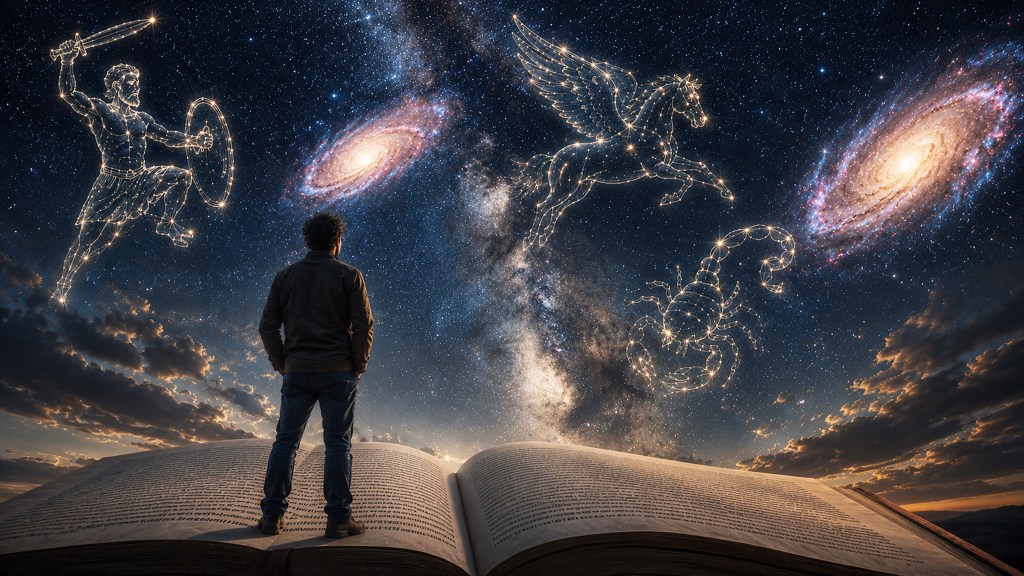
I believe what we call reality is just a bunch of stories we tell ourselves. There are objectively real physical objects out there in the universe. But if we see the lights in the night sky and think of the adventures of Greek gods we are living in a very different reality than if we see those same lights and think of planets revolving around suns as part of a galaxy of billions of suns.
In the same way, lots of real people have lived over the course of history and they did a lot of different things. But the way we organize our understanding of people and events creates the world as we know it. Stories are how we organize the facts of the world around us.
This is why what we teach kids in history classes is always controversial. The details of history might be objective, but how it matters how we choose to arrange those details and interpret their meaning. In the U.S., are we the descendants of brave pioneers who came to a new continent to create a new and better society? Yes. Are we also the descendants of people who couldn’t or wouldn’t do the work of creating a new society on their own and decided to enslave other people to do the work for them? That is also true. When we have the courage to tell both sides of this story we begin to realize that humanity, in every generation, is capable of great good and great evil. If we favor only one part of the story we impoverish our understanding of ourselves.
As it turns out, none of my ancestors did any of those things. All of my ancestors arrived in the U. S. in the twentieth century. But as a person raised in the U.S., the stories of the events of this land have become my history. They are the reality I adopted while listening to the stories told in American history classes.
We have always needed and will always need competent storytellers in our lives. Every child loves stories. Every adult reads books or watches movies or TV or listens to the stories politicians tell us. We are hungry for stories. We understand the world around us based on the stories we’ve been nourished by over the course of our lives. These stories are always biased. All of them advocate for a different version of reality.
As I writer, I feel compelled to tell stories as I assert my view of reality. Throughout my life I have loved learning new stories, both fact and fiction. I’ve loved watching characters in those stories develop and I’ve loved experiencing how a plot twists and resolves. I’ve always wanted to advocate for my own version of reality through the telling of stories.
The worlds I create are always worlds I believe in. They are good and bad in the same way I see the “real” world to be. They are as complicated and inscrutable as the real world. People in my stories are as heroic and flawed as real people. At least, that is my goal.
I create worlds and characters I enjoy spending time with. Writing takes vast amounts of time. If I’m going to spend that much time somewhere, I want it to be a place where I can learn and grow, where I can see the world in a new way, and also where I can sometimes just relax and enjoy myself.
About the author: Doug Dalglish has been an electrical engineer, a US Marine, and a Presbyterian pastor. He is also an avid naturalist. He brings all of these worlds together in his writings. He and his wife raised their family in the rugged hills three hours east of Ciudad Acuña, Mexico. It is this wild land that sparked many of his most imaginative stories. From near-future cautionary tales to Stone Age science fiction, his most improbable stories rise from the strangeness of the natural world.