Remember When, by David Clear

(Note: this blog will occasionally post responses to writing prompts I give to the Second Shore family of authors. The current one: Is there a story, theme, character, experience, or question that keeps finding its way into your writing? Why do you think you keep returning to it? – Krin Van Tatenhove, Founder and Editor)

Without a doubt, the story that has absorbed my consciousness into journals, short stories, poems, essays and novel drafts; the story that I can’t, won’t, and will likely never stop telling, or try to stop telling better, is the quest for spiritual understanding.

It began at a young age when I was barely able to read and write. A death in the family, an out of body experience, vivid, unexplainable dreams…

Reaching adolescence in the late 1960’s, the subjects of New Age spirituality and higher consciousness were quite prevalent. Psychedelic drugs played a large part. Had the opportunity presented itself, I would have tried them but I like to think divine intervention blocked me from going down that road. I was able, however, to enthusiastically pursue the topic in books.

After a lot of philosophy, psychology and nonfiction metaphysics, I discovered an author within the fiction genre that inspired me and set me in a revelatory writing direction. The lyrical prose of Thomas Wolfe in Look Homeward Angel resonated with my soul. Higher consciousness was potentially all around in everyday life.

Five years earlier, I’d had a profound spiritual experience that I had been struggling to make sense of. The DaVinci Code and The Celestine Prophecy were bestsellers at the time. It occurred to me that attempting a fiction format in a similar vein might be how I could best reach a greater understanding of the growth of consciousness in my life.

And so began in earnest the story I have not been able to stop telling. I almost feel as if, like Leaves of Grass, it has become, and will be, my one and only true story, evolving and expanding from a basic origin as years go by.

I worked on Dreaming at the Speed of Sound for thirteen years before self-publishing. It was a labor of love to try to create an intriguing plot within both realistic and surrealistic settings, and characters of depth struggling for a transformation of consciousness.  

I enjoy scholarly, educational prose that can scientifically dissect and detail higher consciousness structures, but Thomas Wolfe can take a description of delivering newspapers in the predawn and transform it into prose poetry which transports the reader equally well, if not better, into higher realms of meditative musings. There are more and more such writers to be found online, and I heartily encourage and recommend them.

If there is a story you can’t stop telling, even if only to yourself, it is a story that very much needs to be told.

In her essay, The Site of Memory, Toni Morrison sums up beautifully what I am saying her.

“You know they straightened out the Mississippi river in places to make room for houses and livable acreage. Occasionally the river floods these places. ‘Floods’ is the word they use, but in fact, it is not flooding; it is remembering. Remembering where it used to be. All water has a perfect memory and is forever trying to get back to where it was. Writers are like that; remembering where we were, what valley we ran through, what the banks were like, the light that was there and the route back to our original place.”

About David Clear: “I’m a New England writer; plainly a hobbyist rather than a professional. I had no formal writing education, but many great writing teachers, from office jobs to heartbroken relationships, and even convenience store clerks. I am retired, and I guess I’m still seeking my great writing whale. David’s recent collection of short stories called The Role of a Lifetime: Stories of Reincarnation in the Theater of the Soul is available for free download here, courtesy of the author and Second Shore Publishing.

The Story I Can’t Stop Telling, by Ralph Bland

(Note: periodically this blog will feature responses to writing prompts I give to the Second Shore family of authors. The current one: Is there a story, theme, character, experience, or question that keeps finding its way into your writing? Why do you think you keep returning to it? – Krin Van Tatenhove, Founder and Editor)

Ghosts. Now there’s a subject folks have been using for story fodder since writing came into vogue. Think of Shakespeare and Dickens and Stephen King. Think of Hamlet’s father, Marley in his chains, or the twins at the Overlook Hotel—just a few of the ghosts, other worldly presences, and visitors from the grave in fiction. Since my childhood I have always been fascinated when a member of the Spirit World grabbed my attention or made an appearance to me either in print or film or oral history, and for seven decades that feeling has never left me.

Since 1998 I’ve published a host of novels, and looking back on their plots and themes and characters, I find there is a long list of appearances by ghosts or their occult brethren showing up consistently in my writing, even when I never planned on such occurrences to take shape in my initial outlines. Whatever the reason, the bottom line is I can’t seem to escape my personal literary supernatural guides, even if I tried.

In my first novel entitled Once in Love with Amy, the title character Amy was already dead and spoke to and visited the other characters from her grave. So yes, I was off and running. Since then I have had a ghost dog named Hobo visit his former master to help him cope with the real world, a beautiful lady ghost who visits a bartender after closing time each night, a man killed by accident lingering around the earth before departing for the Hereafter simply to make things right before he goes, a former lover who walks through a man’s imagination who he makes love to regularly, a host of graveyard denizens who tell their stories from their graves, a faithful dog who goes to heaven after his death but comes back and visits his earthly family from time to time, and a man whose neighbor is convinced he has died but can’t explain why the man is sometimes seen outside his old house at night walking his dog. These are but a few of the ghosts and spirits who consistently grace my plotlines, and I have often wondered why it is I need them to be a part of my stories in some form or another.

Perhaps when it all comes down to it, I have no real sense of what is happening before my own eyes in the real world where I am supposed to be garnering some truth to pass on to my readers. It could be that I need a ghost or a pooka or a boggart or some such member from the other side who’s experienced in the ins and outs of life because they’ve been there before. They’ve had the benefit of being a Monday Morning Quarterback as far as the propensities of life are concerned, the time to sit back and take stock of what has gone on before them, and these ghostly guides are able to encapsulate and understand the sometimes strange movements the planet takes in its spinning. They are able to relate to me those facts and happenings within the living on Planet Earth. Facts and happenings that I am unable to comprehend the who, what, when, where, and whys of.

Maybe the citizens of the Great Beyond have wisdom bestowed upon them because of their past experiences of erring or being successful at daily living and are able to pass their knowledge to me, a mere novice at this comprehension/wisdom scenario of the ages, and their facts and details are necessary to create a story. Or maybe the ghosts I employ in my writing are references I consult to make certain I am not veering off the fictional interstate and heading off into a culvert where my characters and plots and themes don’t have the first inkling of how the world really moves around and goes its way gathering up knowledge to take to the grave with them. I am convinced that these ghosts who visit me in the process of storytelling come forth to lead me down pathways I wouldn’t have known were there without being shown the way.

I confess I’ve even seen a few of these spirits in my own life, or at least I’ve imagined I have, maybe in much the same way I encounter them in the throes of a manuscript, when I’m stuck on a fact or a face or a place I’ve never been before, and that is when my otherworldly amigos show up and tell me where to follow and what to remember, to go with them a while and learn from them precisely what is real and what is not. At this point I’ve learned not to question their existence but rather rearrange the story some and allow my writing associates to show me which way the plot goes from here.

Ralph Bland is the author of seventeen novels and four collections of stories. His work includes Stars Rain Sun MoonLockhart, and Lamb White Days. Ralph is a graduate of Belmont University, married with a daughter and three very spoiled dogs, and on numerous occasions likes disguising himself as a normal person. When not coercing himself to write he spends his time suffering over the heartbreaks of the Vanderbilt Commodores basketball team, lounging in his backyard with his adorable dogs, or tinkering with his 1949 Wurlitzer jukebox, trying to determine why one day it works and the next day it doesn’t, knowing full well that because he is a mechanical idiot he will never know the answer. A lover of Universal monster movies and British sports cars that don’t run, he is the proud owner of perhaps the South’s largest Frank Sinatra audio collection, as if that has anything to do with the price of tea in China. His most recent novel, Pretty Boy, is downloadable for free here or you can purchase it in eBook or paperback formats here.

Deputy Meadows

The first thing that registered was the smell. Not whiskey or beer, but damp earth. Somewhere nearby, a grackle screeched from a telephone wire and irrigation pumps throbbed in the distance.

Steve opened his eyes to a sideways view of a cotton field, its furrows stretching toward the rising sun. The plants had recently been harvested, leaving remnant puffs littered across the soil. A pair of white-winged doves burst from some roadside weeds, their wings whistling as they passed his line of vision.

For another moment, he lay there, looking at the world askew. Then he sat up painfully and saw that he was on the shoulder of a remote caliche road, buck naked.

“Fuck,” he whispered, the word scraping his dry throat.

His skull pounded, his stomach churned, and every muscle felt as though someone had taken him apart and put him back together with rusty bolts. He pressed both palms against his temples and closed his eyes. Think. What happened?

Nothing at first, and then, like shattered pieces of a mirror rising to the surface of muddy water, fragments returned. Music blaring through his truck speakers. Warm air pouring through open windows. Tossing an empty pint bottle and beer cans into the darkness along with six months of sobriety, his laughter echoing across empty fields.

He swallowed hard.

“Not again…” he whispered, overcome by waves of shame. He forced himself to stand, swaying until his dizziness settled. Looking down the gravel road, he spotted his late model truck about a hundred yards away, sitting with its hood cocked toward the sky.

He started towards it, caliche crunching painfully beneath his feet. Every few yards, he came across another article of his clothing: his underwear, his boots, his socks, his chinos, then his button down shirt hanging from a fence post. It had been neatly folded, and he stared at it for a long moment, shaking his head.

“At least part of me was still neat,” he said with a grim chuckle.

He dressed slowly, his shirt stinking of spilled beer. By the time he reached the pickup, the full extent of his predicament was clear. Its rear wheels were buried deep in a roadside drainage ditch, weeds twisted around the axle. All the windows were wide open, and dried mud blotched the doors and fenders.

Shaking his head again, he climbed inside. The key fob was on the dashboard, but when he tried to start the engine, it was dead, the gas gauge well below empty. He picked up his cellphone from the passenger seat and pressed the power button. Nothing happened.

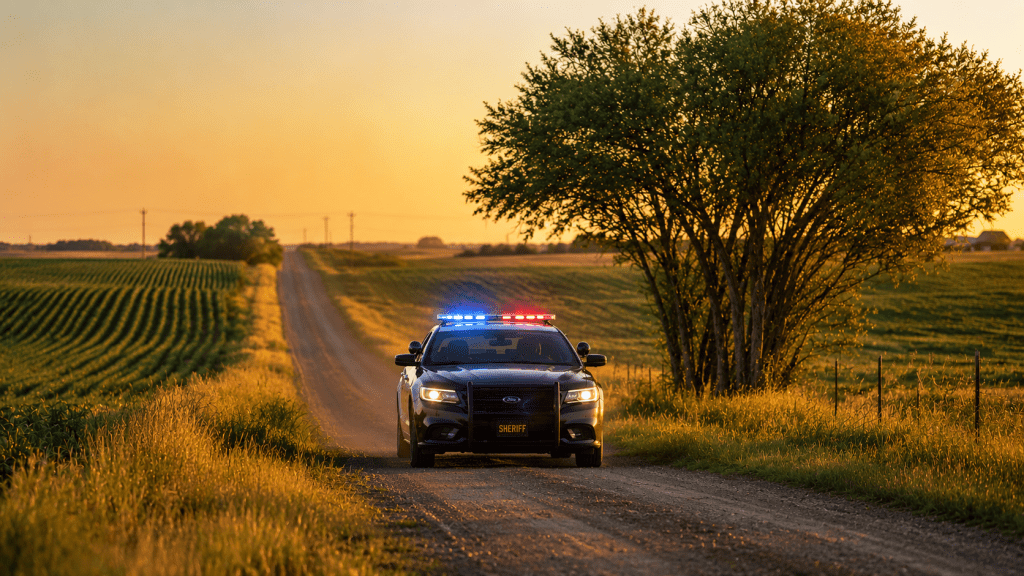
He let out a long, weary breath and rested his forehead against the steering wheel. A moment later, gravel crunched nearby, and he lifted his eyes to see a county sheriff’s cruiser approaching along the road, early sunlight glinting on its windshield. It came to a stop beside the pickup, engine idling as the driver’s door swung open. The man who stepped out appeared to be in his late fifties, wearing his uniform and his years comfortably. Gray touched the edges of his mustache, while the lines around his eyes suggested someone who smiled often despite the seriousness of his role.

The officer looked over the truck before turning his attention to Steve. “Good morning. I’m Deputy Meadows. A rancher driving by about twenty minutes ago spotted your pickup and called us.”

“I figured somebody would,” Steve said in a hoarse whisper.

Meadows walked closer. Even outdoors, the smell of beer and sweat reached him. “Please show me your license and registration.”

Steve’s wallet was still in his back pocket, so he pulled it out, removed the license, then rummaged through the glove compartment, handing both documents through the window. Meadows looked them over carefully.

“You’re a ways from home, Steve Hansen. Mind telling me what happened?”

Steve gave a humorless laugh. “Truck slid off the road.” He paused, looked away from the officer, then back again. “Guess I had a bit to drink.”

Another pause as the officer waited, knowing that silence often uncovered new levels of honesty.

Steve’s shoulders slumped. “Shit, I remember throwing cans and a bottle into the fields like an idiot teenager. Everything after that…it’s gone.”

Meadows nodded slowly. “I think you know what I’m going to say.”

Steve looked at him. “That I was wasted?”

“Obviously. Blackout wasted. More importantly, you could have killed yourself or someone else.”

What struck Steve was that Meadows’ voice remained neutral, just the truth spoken without an incriminating lecture. He rubbed his hands across his face, fully expecting Meadows to cuff him and take him to the station.

“I don’t deserve a break.”

Meadows looked into the distance for a second, as if struggling to decide what to say. Steve noticed a scar running down the side of his face. “I’m not here to decide what you deserve.”

A breeze swept across the fields, carrying the scent of sun-warmed soil and blooming huisache.

“I’ll call a tow truck,” Meadows said.

Steve shook his head. “I’ve caused enough trouble. I’d rather go home. I’ll charge my phone once I get there and make the arrangements myself.”

The deputy raised an eyebrow. “And how do you propose to get there? An Uber?” He chuckled softly. “Is there someone I can call to come get you?”

Steve just shook his head.

Meadows studied him another moment. “Tell you what. I’ll give you a ride home.”

Steve looked into Meadows’ eyes, surprised by the offer.

“Okay. I’d appreciate it.”

Steve closed the truck’s windows, locked the doors, then climbed into the patrol car and they took off. The interior smelled of stale cigarette smoke. For several miles neither of them spoke as the county road wound between cotton fields and sorghum, passing rusted windmills, double-wide trailers, weathered barns, and mailboxes listing to their sides. A tractor worked slowly in the distance, throwing small clouds of dust into the growing heat. Steve watched it all roll by, his head pounding.

“Do you have kids?” Meadows finally asked.

“No.”

“Wife?”

Steve didn’t answer immediately. “Separated.”

“For how long?”

“Eight months.”

Meadows glanced at him. “Because of the alcohol?”

Steve nodded. “She stayed longer than she should have. Years of promises. Years of me swearing this time would be different.”

He looked down at his hands. “The day she left, she packed two suitcases, kissed me on the cheek, and said something I’ll probably hear the rest of my life.”

Meadows waited.

Steve swallowed. “I still love you, Steve, she told me.” He managed a tired smile. “I almost wish she’d been angry. Anger would’ve been easier.” He stared through the windshield. “Then she said, I just can’t stay here and watch you disappear.” His voice grew quieter. “She never filed for divorce. Just gave me one condition.”

Meadows didn’t interrupt.

“When you choose sobriety instead of alcohol, call me.” He gave a humorless laugh. “Then last night.”

Meadows was silent a bit, then started tapping his fingers on the steering wheel. “I was…” He stopped, as if uncertain to continue, then sighed. “I was sober six years before I pinned on this badge. That was fifteen years ago, and I still haven’t touched a drop.”

He didn’t say it in a boastful way. Steve turned fully toward him, the officer’s eyes steady on the road.

“I started drinking in high school.” Meadows continued. “It made me more confident, and I thought it made me funny. Then I thought it made me braver. Eventually it just made me thirsty.” He paused. “I lost my first marriage. I lost a construction business. I almost lost my little girl.”

The patrol car hummed along the pavement. Steve had never expected such a confession. “What happened?” he asked quietly.

“I passed out one afternoon while I was supposed to be watching her.” Meadows swallowed. “My neighbor found her wandering along the highway.”

Steve stared out the windshield. Neither man spoke for nearly a minute as the fields slowly gave way to scattered live oaks.

“I figured my life was over,” Meadows continued. “I honestly believed I’d become the worst thing that had ever happened to the people who loved me.”

“What changed?”

“As they say in the program, I got sick and tired of being sick and tired.” He tapped the steering wheel again. “I finally admitted I couldn’t beat it alone.”

Steve looked down at the caliche dust on his boots. “I hear you. I admitted that powerless thing six months ago. I started going to meetings, got a sponsor, the whole deal. I even became open to there being a Higher Power who could help me.” He paused. “Then last night I flushed it all away.”

Meadows laughed, the last reaction Steve expected.

“You think that’s original?” asked Meadows. “You think you’re the first one to relapse? Believe me, man, relapsing is the main symptom of this disease. You just have to shake off the shame, get back on your feet, and start again.”

‘Yeah,” said Steve, “but now my chances of getting Linda back are pushed to the outer limits.”

The sun had climbed above the horizon, pouring gold across the landscape. In the distance, they could see the rooftops of the housing development where Steve lived, and further away, the skyline of the city where he worked as an actuary for a large insurance firm.

“It sure is a beautiful morning,” Steve murmured.

Meadows gestured toward the windshield. “When I drank, I stopped seeing mornings like this. Everything became about the next drink. The rest of creation just disappeared.”

The patrol car’s GPS was set to Steve’s address, so Meadows followed it into the subdivision, made the requisite rights and lefts, then pulled to the curb in front of Steve’s house.

“This it?”

Steve nodded. His ranch style home had a manicured lawn and a live oak tree in the front yard. The porch swing that Linda loved was creaking slightly in the morning breeze. He reached for the door handle, then paused. “I really appreciate the ride, Deputy Meadows. And the conversation.”

Meadows nodded, again seeming unsure of what to say. “I’ve always been one to bristle at unsolicited advice. People should mind their own damn business. But given the fact that we’re both alcoholics and I just hauled your ass out of a ditch…”

He stopped and looked through the windshield for a moment. “Truth is, I almost kept my mouth shut.”

Steve waited.

“But twenty-one years ago, an old deputy named Flores picked me up after one of the worst nights of my life. He drove me home, parked in front of my house, and talked a whole lot longer than I wanted him to.” Meadows smiled to himself. “I remember sitting there thinking, who asked you?” He shrugged. “But it turned out I needed somebody who didn’t wait to be asked, so I’m going to have my say.”

Meadows rubbed the back of his neck, then looked at Steve. “I’ve arrested judges and janitors. Ranch hands and accountants. Rich people. Broke people sleeping under bridges. Alcohol doesn’t care who you are. We all end up sitting in the same folding chairs, taking it one day at a time. Get back among those folks, Steve. You need them.”

Steve nodded. “I hear you.” Then he started to open the door.

“I’m not done,” said Meadows a bit more forcefully.

Steve turned back toward him, struck by the gentleness in Meadows’ eyes.

“Don’t do this for Linda. She may come back or you may never see her again. Job one is saving your own life. Let the rest sort itself out. And remember, no matter how far you’ve walked into the darkness, you can turn around. Right now. Today.”

Steve nodded. “I think…” His voice cracked. “I think I’m just really scared.”

“Good. It means you’re telling yourself the truth.”

Meadows reached toward his pocket, hesitated, then slipped his fingers into it and pulled out a card. He handed it to Steve. “I don’t usually do this, but you can call me anytime, day or night. I mean it”

They sat quietly for another few seconds while the breeze stirred the oak tree in the yard, scattering patches of sunlight across the hood of the patrol car. Steve opened the door and stepped onto the cement walkway leading to his front door. The swing on the porch moved again. He remembered Linda sitting there on summer evenings with iced tea, watching thunderstorms gather over distant fields. He remembered the smell of her shampoo and the way she laughed so freely. She would often ask him to sit beside her on the porch, but too often he’d chosen the bottle instead.

He turned back to Officer Meadows who was still idling by the curb. “Thanks again.”

The deputy tipped two fingers to the brim of his hat. “I hope the next time I see you, it’s not by the side of a road.”

“So do I.”

Steve watched the patrol car do a U-turn toward the entrance of the subdivision. Then it turned a corner and vanished.

For a long time, he stood without moving. Even in his hungover state, he could appreciate the sound of the wind moving through the oak leaves and the light touch of the breeze on his skin. Tears blurred his vision and he let them come. When they had passed, he walked up the path and reached the porch, its boards creaking beneath his boots. Then he sat in the swing, rocking back and forth. The full light of morning settled over the yard as though it were the second day of creation, the world beginning again.

Getting up stiffly off the swing, he went inside where the house seemed unusually quiet. He found the charger in the kitchen drawer and plugged it into his cell phone. It took almost a minute before the screen came alive.

When it finally lit, he didn’t hesitate. He called AAA. Then he called his sponsor.

Special of the Week

“It’s cold as a witch’s teat out there,” Jimmy “Fastball” Burns exclaimed as he bustled through the main entrance of Everybody Rides used car lot, passing out cheeseburgers, fries, and steaming cups of coffee.

“I ain’t never seen a cold spell like this in the middle of December.”

“You got that right!” agreed Sam Jenkins, also known as Sam “Batboy” Jenkins.

Buzz “Homerun” Renfro took a sip of coffee. “Why don’t you two yahoos shut up and pass me some fries before they get cold.”

J.J. “Coach” Moran, the manager, looked at the three salesmen with mild disgust, the way a father would look at his rambunctious children. “Why don’t all three of you quiet down so I can finish this here book on Joe DiMaggio, the greatest baseball player who ever lived.”

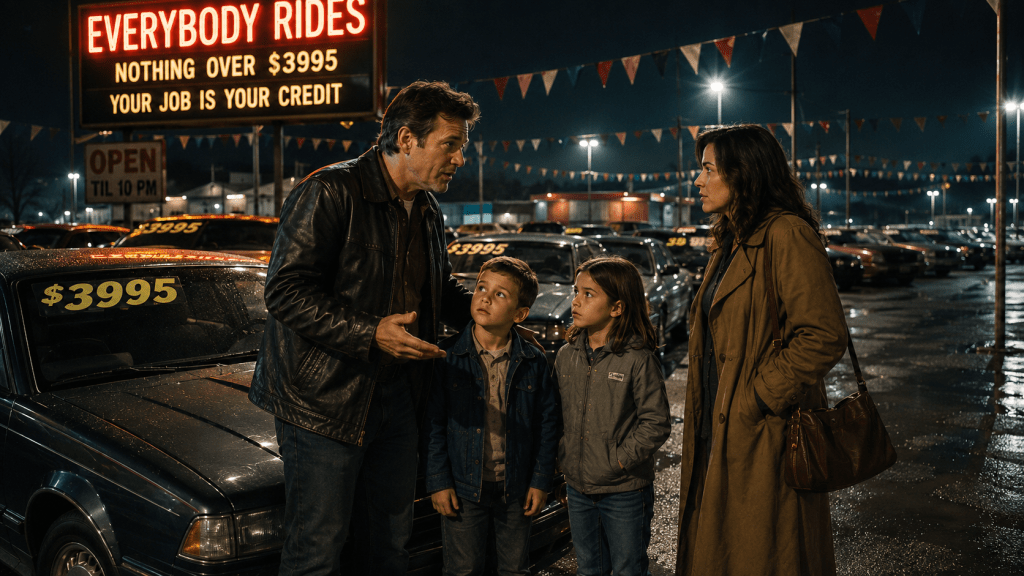
Everybody Rides was the budget used car lot of the mega-dealership, King of the Road Jaguar, Chrysler, Dodge, Kia, Daewoo. In automobile sales, this was the bottom of the barrel. The good used cars were on display in a paved lot adjoining the new car dealership. Everybody Rides was located two blocks from the other lots. King of the Road owner, Wild Bill Hancock, didn’t want a car lot that proudly displayed in bright red letters under its name—NOTHING OVER $3995 and YOUR JOB IS YOUR CREDIT— to be too closely associated with the classier side of his business. As an added punishment, Everybody Rides had to stay open until 10 p.m. while the rest of the dealership closed at 9:00 p.m.

If an outside observer were to come to the conclusion that Coach had a thing for baseball, he or she would be right on the money.

He had coached Little League baseball for over thirty years and never had a winning season. But to hear him tell it, he had always been one hit or pitch away from baseball glory.

The only sounds in the office that evening were the four men inhaling their supper as they chewed, gulped, and belched their way down to the last French fry. Each man had his own story of what brought him to this place. Coach had successfully managed the upscale used car lot for ten years before he punched out an opposing Little League coach who happened to be the cousin of Wild Bill Hancock. The others were exiled to Everybody Rides for different reasons, and in keeping with his passion for baseball, Coach had given each of his “players” a nickname.

Jimmy “Fastball” Burns had been the leading Dodge truck salesman for three years in a row. Nobody knew more about pickup trucks than he did, and nobody could close a truck sale as quickly. Unfortunately, Fastball decided to celebrate his third divorce by driving off in a brand new loaded Dodge Club Cab that he hadn’t cleared with the manager. With a fifth of Jim Beam riding shotgun, he totaled both the truck and his sales career.

Sam “Batboy” Jenkins was a wiry fellow with nervous eyes. Coach had given him that name because, as he frequently reminded him, “Boy, you ain’t even in the game. You can’t score if you don’t get to the plate.” Coach used to call him Third String, but after three consecutive months at the bottom of the sales ladder, demoted him to Batboy.

Sam was the only one of the four men who had never been married. He had allegedly had only two dates, and one didn’t count—the occasion of his senior prom when he paid his next-door neighbor, Debbie Ann Muskgrove twenty dollars to accompany him. Rumor had it that he offered to pay her another five dollars for a goodnight kiss. The truth was that Debbie Ann told Sam the only part of her he could kiss for five dollars was her ass.

Before Buzz “Homerun” Renfro was exiled to Everybody Rides, he was the leading salesman at King of the Road for three years running. Then he hit a homerun of a different sort with Wild Bill Hancock’s personal secretary at the annual office Christmas party who also turned out to be Wild Bill’s secret Santa.

Coach was married to his second wife. Fastball was, as he liked to put it, currently “playing the field. Buzz, also divorced, was heavily involved with Darlene, a former dancer with Sand and Sun Cruise Lines. She was presently employed as senior nail technician for The New You Salon.

Buzz and Darlene had been together for more than a year and, although he had told no one, he was planning to pop the question on New Year’s Eve.

Leaning back in an office chair with his feet propped up on his desk, Buzz fingered the gold-plated money clip in his left front pocket that secured the five one hundred dollar bills he had saved to buy Darlene’s engagement ring. He smiled in anticipation of her excitement. No one could get as excited as Darlene. Buzz’s daydream was abruptly interrupted by the grating voice of Fastball.

“Customer on the lot. It’s your turn, Renfro,” he bellowed.

Buzz lit a Marlboro Light and peered out the office window into the cold, black December night. Who would be looking for a used car at 8:45 on a cold Saturday night? Blowing a spiral of smoke rings toward the ceiling, Buzz said, “Why don’t we give them a few minutes to see if they are really serious.”

Without taking his eyes off the page he was reading, Coach took charge of the situation. “Batter up, Buzz. Get your ass out there and into scoring position. Batboy, you’re in the on-deck circle.”

Batboy grinned at Buzz. “I done taken a peek, Homerun. I can tell from here, she ain’t much to look at and more’n likely she ain’t got no money. Them two kids means she ain’t got no man, which means she ain’t got no money, which means you ain’t gonna make no money. Comprendes, amigo?”

Buzz blew another series of smoke rings toward the door. “Two things, Batboy. First, I’m not your amigo, and second, can you Comprendes that?”

Zipping up his parka, Buzz ground out the remnants of his cigarette in the ashtray, closed the door behind him, and stepped out into the cold night.

___

Agnes was cold. Not just from the threadbare parka she was wearing, but cold deep inside, down in her bones. She felt like her heart was almost frozen shut— like it was barely beating. The only thing on this freezing December night that gave her any warmth was her son, Kenny, and her daughter, Sonja. And they gave her just enough to keep her going a while longer. Ten years seemed like a lifetime ago when she up and married their father, a truck driver twenty years her senior. They met at the small mountain top café where she had worked as a waitress. Harold had promised her the good life, but what he had given her was too many years of misery. He finally left her and the children two years ago with unpaid bills and no goodbyes.

Agnes wasn’t a woman given to bitterness, she was just tired. Somehow, having Kenny and Sonja made the misery worth the trouble. At eight and six, they were still young enough to make up the difference between the poverty and hopelessness with a few well-practiced dreams, the most recent being what Santa Claus might bring them. At least, Sonja had that dream. Agnes wasn’t sure about Kenny. He acted happy enough, but she had seen the sad, uncertain look in his eyes when he thought she wasn’t paying attention.

Working two jobs, one at a nursing home and the other at Taco Bell, didn’t provide much of a life. They had been evicted from their apartment for unpaid rent three days after her truck had been repossessed. Agnes had no illusions about her chances of getting the salesman walking towards her to sell her a car for a fifty-dollar down payment, but fifty dollars was all she had.

___

“How do you do, Ma’am? You gotta a couple of fine-looking children. Name’s Buzz Renfro. What can I do for you?”

Agnes looked at the salesman for several moments before she spoke. “Mr. Renfro, my name’s Agnes Davis and these here are my children, Kenny and Sonja. We are in great need of a reliable vehicle.”

“Yes ma’am. Well, you’ve come to the right place because reliable is our middle name. Every vehicle we sell has undergone a 21-point inspection.”

“Mama,” Sonja interrupted, “I’m hungry!”

“Hush Sonja, we’ll get something to eat when we finish our business with Mr. Renfro.”

Dropping her head at the tone of reprimand in Agnes’s voice, Sonja buried her face in Kenny’s jacket.

“Tell you what kids, how ’bout candy bars and cokes on me while your mother and I check out the cars,” Buzz offered, pulling three one dollar bills out of his pocket.

“I couldn’t let you do that, Mr. Renfro,” Agnes protested.

“I ain’t hungry anyway,” Kenny added, stuffing his hands in the pockets of his denim jacket.

“Well, I am,” Sonja exclaimed, peering from behind the folds of her brother’s jacket.

“Hey, I insist,” Buzz responded. “Besides, you’ll be warm inside. Ask for a Mr. Moran when you get inside. He’ll show you where the goodies are.”

Agnes relented and Kenny took the three dollars and Sonja by the hand and proceeded toward the office. Buzz lit another cigarette as he and Agnes stood watching the vapor trail of Kenny and Sonja’s breathing as they made their way toward food and warmth.

“Now, Mrs. Davis, what would you like to look at? We only have about an hour until we close.”

Agnes’ eyes escorted her children into the office. “Mr. Renfro, I’m going to be honest with you. I’m in desperate need of a vehicle. I have two children, two jobs— if I can come up with transportation— nowhere to live, and fifty dollars in my right coat pocket.”

Buzz took a deep draw from his cigarette before he spoke.

“Ma’am, please don’t take this the wrong way, but it sounds to me like you need a lot more help than just a vehicle— at least more help than I can give you. You need to get hold of some area churches or the Human Services Department or something like that. Besides, the cheapest vehicle on our lot requires a down payment of several hundred dollars. Maybe you ought to call your family.”

Agnes turned her head slightly to compose herself. “No offense taken, Mr. Renfro. Don’t have no family, but I’ll figure something out.”

She took a deep breath and extended her hand. “I want to thank you for the kindness you showed my children. I’ll be fetchin’ them now.”

“Well, Ma’am, at least let me get you a hot cup of coffee.”

“Thank you, but that won’t be necessary,” Agnes replied as she walked toward the office, leaving Buzz to ponder the crisp night air.

“Hellfire,” Buzz muttered to himself. “Why do I always have to get the hard-luck customers? Life’s tough for everybody.

He could see Kenny’s and Sonja’s faces peering out of the office window as their mother approached them and thought to himself, Where will they go? What’ll happen to them? What does it matter to me? It don’t.

 All Buzz had on his mind was the wad of cash in his pocket and Darlene. He popped a piece of chewing gum into his mouth and pretended to check the cars on the lot. He also pretended it would be less embarrassing for Agnes and her kids if he waited until they left.

Buzz watched as Agnes and her children made their way across the car lot toward the bus stop on the corner. As they started to cross the street, Sonja turned and waved to him and shouted, “Hey Mister! Thank you for the candy. I hope you have a Merry Christmas!”

It was at that precise moment that Buzz Renfro went temporarily insane.

He might as well have been hit by a meteor from outer space. The gold-plated money clip in his pants pocket seemed to turn white hot. He felt dizzy, his knees buckled slightly, and even with the chill of the night air, he could feel a bead of sweat break out on his forehead.

Somewhere between Sonja’s “Merry” and “Christmas,” something— some great mystery traveling faster than the speed of light—had penetrated Buzz Renfro and knocked him senseless. In that moment, the fake gold nugget ring on his right hand ceased to exist. Even the image of Darlene became little more than a dancing shadow. Buzz was pulled out of himself into a place he had never been before. It was as if he was having an out of body experience, observing himself running toward Agnes and her two children who were standing under the streetlight, waiting on the rest of their lives.

As he ran, his mind was saying stop, but his legs weren’t listening.

When he caught up with them, Buzz bent over and grabbed his knees, breathing heavily.

“Mr. Renfro, are you all right?” Buzz took a deep breath, sucking the cold air into his lungs. “Yes ma’am, I believe I am. It just occurred to me that we might have a vehicle suitable to your needs.”

“But I told you, I only have….”

Buzz interrupted her, “I forgot to tell you about the special of the week. If you could use a 1992 minivan, you could drive it away tonight for no down payment and one hundred and twenty-five dollars a month.”

“I don’t know what to say,” Agnes’ eyes widened.

“Say yes, Mama. Say yes!” Sonja exclaimed, jumping up and down as Kenny looked on silently.

“Yes,” Agnes said, her face freed up by the hint of a smile, the first she had felt in weeks.

Agnes with her coffee and Kenny and Sonja with their hot chocolate waited in the customer lounge while Buzz filled out the paperwork.

Batboy shook his head. “I would’ve bet a month’s pay that lady wouldn’t have two cents to her name. Can’t believe she’s got the cash for the down payment.”

“Well, believe it,” Buzz replied as he signed the last of the finance forms.

Draining the last of his coffee, Coach looked solemnly at Buzz and cleared his throat. “Well, Homerun, it wasn’t one of our better units— certainly not of home-run caliber, but I will give you an infield hit.”

Buzz handed Agnes the keys. Even Kenny seemed excited. Not like Sonja, but at least pleased. Looking at the keys in her hand, Agnes didn’t say anything. Instead, she put her arms around Buzz and placed her head on his chest. He didn’t know what else to do so he hugged her.

As the minivan left the lot of Everybody Rides, all Buzz could see was the smiling face of Sonja pressed against the rear glass window. Her smile went right through him. His fingers grazed the empty money clip. It wasn’t hot anymore. And he knew Darlene probably wouldn’t be coming down his chimney on Christmas Eve.

Opening a fresh pack of cigarettes, Buzz looked up at the glittering stars and said to no one in particular, “Merry ‘hotdamn’ Christmas.”

About the Authors

Michael Braswell: A former prison psychologist, Michael Braswell taught ethics and justice issues at East Tennessee State University. He has published books on moral issues, ethics, human relations and counseling as well as four short story collections. His most recent books are The Light that Remains: Stories of War and Consequence, When Jesus Went to the Cracker Barrel, and Gracious Plenty. His website is michaelcbraswell.com

Scott Braswell: Director for Marketing and Social Media for the School of Pharmacy at the University of Washington in Seattle, he received his M.A. degree in Creative Writing from East Tennessee State University. He has held previous positions in Communication, Social Media and Marketing including at the University of North Carolina at Chapel Hill, North Carolina State University, and Hearst Media. He is the coauthor of Morality Stories.

The Road South

Paris Martin paused to straighten his broad shoulders made strong by years of fieldwork. He wiped his brow and swept his eyes over the plantation.

On the surface, everything seemed the same. The Chamberlain’s house, an inn for travelers on the Natchez Trace, stood on its knoll. Cotton fields stretched across the landscape, shimmering with heat. Cicadas droned from the woods, and a red-tailed hawk circled lazily overhead. Paris breathed in the familiar smells of damp earth and mule sweat from the nearby wagon yard.

Yet beneath it all, something had shifted. Travelers staying at the inn had relayed some startling news. Vicksburg had fallen and Yankee troops had occupied Natchez. Enslaved people were escaping across the region and finding refuge behind Union lines. Most astonishing of all, Black men could enlist in units of the United States Colored Troops, putting on uniforms and carrying rifles.

At twenty-two, Paris had spent his entire life at Mount Locust. Every mound, stream, and stand of trees was familiar to him. Yet now his thoughts drifted toward Natchez beyond the southwestern hills, where an unfamiliar life seemed suddenly possible.

“If you stare hard enough, maybe it’ll come walking over here.”

Paris turned and found his brother Anthony grinning at him from the next row in the cotton patch. Lean and quick on his feet, Anthony carried an irrepressible smile that hardship never managed to erase.

“What will?”

“Natchez.”

“That’s foolish.”

“So is standing in the sun daydreaming.”

Paris chuckled. Anthony always found humor, even on the hardest days. Their mother used to say that if the world ended, Anthony would ask whether there might still be supper afterward. She had needed that kind of laughter since their father died.

“I’m not daydreaming.”

“Then you’re thinking about something solid.”

“Maybe.”

Anthony lowered his voice and glanced toward the far end of the field.

“About the Yankees occupying Natchez?”

Paris hesitated. The enslaved at Mount Locust had more privileges than others in Mississippi. Their owner, Paulina Chamberlain, sometimes allowed them to visit a nearby plantation to socialize, a freedom unheard of elsewhere. But to think about escaping for good? That was a different prospect.

“Maybe.”

Anthony nodded. “Me too. Imagine being able to join up and fight against the Confederacy. To bear arms…”

For a while they worked in silence beneath the scorching midday sun. Sweat trickled down Paris’s neck until his homespun shirt clung to his back. Despite himself, hope began to stir inside him, a dangerous thing that tempted a man to imagine a life beyond the one laid before him.

___

Later that afternoon, the brothers went to repair a fence damaged by a recent storm. The work took them beyond the edge of the main field where they could talk more freely.

Anthony drove a post into the ground and stepped back to examine it. Sweat darkened the backs of their shirts, and every hammer blow sent grasshoppers scattering through the weeds.

“You ever think about what you’d do?”

Paris adjusted another rail.

“If what happened?”

“If you woke up truly free tomorrow.”

Paris considered the question. “Sleep late.”

Anthony laughed. “That’s your dream?”

“For the first day.”

“And the second?”

Paris smiled. “Maybe spend the whole day deciding what to do.”

“You dream too small.”

“What about you?” Paris asked.

Anthony rested both arms on the fence. “I’d walk.”

“Walk where?”

“Everywhere.”

Paris shook his head. “You’d get awful tired.”

“Maybe. But it’d be my choice, and I see parts of this country I’ve never seen.” He studied the distant woods to the southwest. “You think we’d make it?”

Paris drove another nail into the rail before answering. “I don’t know. There’s still a lot of danger out there, especially along the Trace. The Union may control Natchez, but it doesn’t control the minds of those who hate colored people.”

Anthony nodded. “Fair enough, but we’d have each other for protection.” He fell silent for a moment, then said quietly, “I keep wondering if this is what it feels like before your whole life changes.”

Paris stood straight, mopped his brow, and let his eyes drift over the fields. “I know what you mean. Everything looks the same. The fence. The cotton. The trees. But somehow the whole world feels totally different.”

Movement along the distant Trace caught his attention. A group of horsemen emerged from the trees, riding slowly beneath the afternoon sun. Both brothers froze.

 “Who are they?” Paris asked.

 “Most likely a slave patrol,” said Anthony.

The horsemen continued without stopping, but neither brother spoke until they disappeared. The weight of what they were considering settled heavily between them.

___

The brothers sat outside their cabin as the last traces of sunlight slipped beyond the western hills. Smoke from cook fires carried the aromas of cornbread, greens, and salt pork.

An elder named Isaiah approached them. He lowered himself onto a sitting stump with a weary sigh, rubbing one knee before settling into place. Age had bent his shoulders and silvered his hair, but his eyes remained sharp.

“You two look like men carrying secrets.”

Anthony grinned.

“Maybe we’re just thinking.”

“Thinking too much can be dangerous.”

“Then we’re definitely thinking,” said Paris with his own grin.

Isaiah chuckled. “I’ve watched both of you grow up. Neither one of you ever learned to hide your thoughts.” His gaze shifted toward the Trace. “Generations have walked that road searching for something better. Sometimes I think the land remembers them all.” He paused. “Most folks see dirt and wagon ruts. I see hope.”

“You ever think about taking it?” asked Anthony.

Isaiah smiled sadly. “Every day when I was your age.”

The answer surprised them.

“You never tried?” Paris asked.

“Once.” The old man folded his hands in his lap. “I got about three miles from here.”

Anthony leaned forward. “What happened?”

Isaiah laughed softly. “Fear happened.”

The honesty of the answer surprised them.

“I was younger than you boys are now when I left,” Isaiah continued. “I thought I had everything figured out. Then the woods got dark. Every sound became a posse in my mind. Every shadow became somebody looking for me.” He shrugged. “So I turned around.”

One of the Chamberlain’s dogs barked in the distance.

“Do you regret it?” Paris asked.

Isaiah stared toward the fading light at the edge of the southern woods. “Sometimes. Other times I tell myself I made the right choice. Truth is, neither matters now. The chance came but I let it pass.”

His gaze moved back to Paris to Anthony, studying their faces.

“If you boys are waiting for your fear or uncertainty to leave, it won’t. If you mean to go, you’ll have to carry those feelings with you.”

In the distance a whip-poor-will called from the woods, and the night’s first stars began to brighten overhead.

___

The following evening, Elijah returned from Natchez with a small wagonload of supplies. He was a short, compact man with a full beard whom the Chamberlains trusted him enough to send on multi-day trips. After unloading, he walked towards his quarters, dust coating his boots and the cuffs of his trousers. He passed Paris and Anthony sitting outside their cabin.

“I hear you’ve been to Natchez,” Anthony called out to him.

Elijah stopped in mid track and nodded. “I have.”

For a moment he simply looked at them with a weary face, as though deciding how much to say.

“They’re there,” he said at last. “Union soldiers. Colored soldiers too.”

Neither brother spoke.

“I watched them marching through town wearing blue uniforms with rifles on their shoulders.” Elijah smiled faintly. “You should’ve seen the way they carried themselves. Like men who’d finally remembered who they were.”

Paris felt that stirring of hope again. “They’re taking in folks from plantations all over the county?”

“They are.”

Elijah lowered his voice. “If you’re thinking about going, don’t wait too long. Every day more people are slipping away.” He paused. “And the patrols have noticed.”

He rose, lifted a small sack onto his shoulder, and started toward his quarters. After a few steps he looked back. “Hope has a way of not waiting forever.”

Then he disappeared into the gathering dusk.

___

The next morning, Paris woke before sunrise and stepped outside the cabin while the rest of the plantation slept. A pale gray light lingered along the eastern horizon. For a few precious moments, the world seemed suspended between night and day. The air smelled of pine and dew as a faint mist drifted across the low ground beyond the fields.

He stood quietly, listening. Somewhere in the distance a rooster crowed, and a mockingbird called from a nearby tree. Ordinarily, even a beautiful morning like this would have seemed unremarkable, but now it felt unlike any morning before it.

By nightfall, there would be no turning back.

Anthony stepped outside a few moments later, following Paris’ gaze toward the southern woods.

“You nervous?”

“Yes.”

“Good.”

Paris smiled. “You too?”

Anthony laughed softly. “I feel like my stomach’s trying to climb out of my body.”

The honesty of the answer eased something inside Paris. He had assumed that he alone carried the burden of fear.

“What if we get caught?” Anthony asked quietly.

Paris looked across the fields.

“I don’t know.”

“Well, that’s comforting.”

Paris laughed despite himself. It felt good to not know, perhaps because the alternative, as Isaiah had warned, was thinking too much.

___

That evening, after the plantation had grown quiet, Paris and Anthony crossed the yard to their mother’s quarters. She had moved temporarily from their family cabin to care for two elderly women.

She looked up as they entered. Deep lines framed her gentle face, but her steady eyes held the strength of a woman who had endured much and complained little. She knew why they were there.

“So,” she said softly, “it’s tonight.”

Both nodded solemnly.

“Mama…” Anthony began.

She raised a hand to stop him.

“I’ve known this day was coming since the first time I heard you two whispering about Natchez.”

Silence settled over the little cabin. The only sound was the soft crackle of the cooking fire.

Finally Paris said, “We hate leaving you.”

“I know.”

Anthony stared at the floor. “Come with us.”

She stood and stepped towards them, smiling sadly as she shook her head.

“The Lord has a different road for me.”

She reached out and smoothed the front of Paris’ shirt as she had done ever since he was a little boy. Then she took each of their hands.

“Your father used to tell me a man doesn’t get many chances to change the course of his life. If the Lord puts one in front of you, you take it.”

Tears welled in Anthony’s eyes.

“We’ll come back.”

“I’ll pray you do.” She squeezed their hands. “But don’t you look back because of me. You just keep walking.”

She embraced them both, holding them a long while before stepping away.

“Take care of each other.”

“We will,” Paris said.

She smiled through her tears.

___

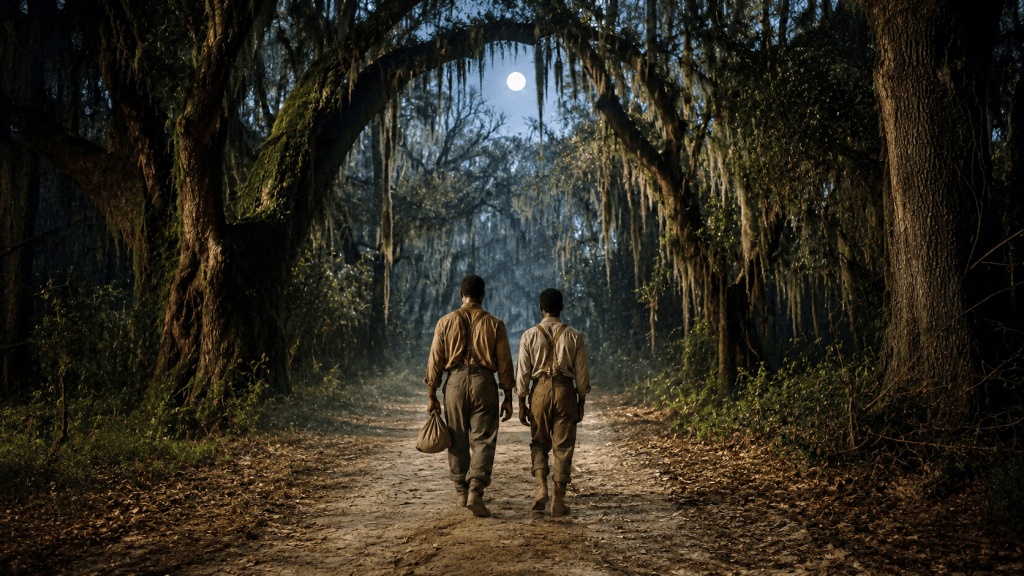
The plantation slept beneath a full moon as Paris and Anthony slipped between the cabins and crossed the open ground. They each carried a small burlap sack containing personal belongings. Silver light washed across the fields while a breeze stirred the cotton. Anthony’s foot struck an old pail, sending it clattering across the yard. Both brothers froze, scarcely daring to breathe as they waited for a lantern to flare or a dog to bark. None did, and the night settled around them once more.

At the edge of the plantation, they stopped at the tree line and turned for one last look. Mount Locust lay beneath the moonlight, the old house watching over the cabins and fields that had shaped every memory they possessed. Paris was surprised by the sadness that rose in him.

“Feels strange,” said Anthony.

Paris nodded.

“You ready?”

Paris turned his eyes south toward Natchez and the uncertain future waiting beyond the darkness. Fear remained, but hope walked beside it now.

“Yes.”

They entered the woods, where the air cooled around them. It didn’t take long to reach the Trace. Both had walked it before, but never like this. It stretched before them into the darkness. Wagon ruts caught the moonlight, and generations of footsteps had worn the earth smooth. Pale sycamores arched overhead, their white trunks glowing in the darkness.

Paris knelt and ran his fingers across the cool, packed earth. He imagined all the feet that had traveled this road before his own: Choctaw hunters, traders, soldiers, settlers, runaway slaves, families seeking new homes. He stood without saying a word.

“When I was a boy,” he said. “I used to imagine owning a horse. Now I’m imagining a whole different life.”

“Come on,” said Anthony. “Let’s find that new life.”

Somewhere ahead a whip-poor-will called. Anthony answered by softly but badly imitating its song. Paris laughed under his breath.

Then, side by side, they followed the Trace into the Mississippi night.

Epilogue, Jefferson County, Mississippi, 2018

The cemetery was quiet except for the rustling of leaves overhead. Time had softened the edges of a weathered government headstone, but the name inscribed on was still readable.

PARIS MARTIN

For years, the fate of the Martin brothers had been unknown. Patient research through church records, military files, and family histories eventually led to the discovery of the enlistment card for Anthony, dated July 20, 1863. Then they uncovered Paris’ grave at Jefferson Chapel African Methodist Episcopal Church. After the war, he had returned to Jefferson County to build a new life.

Freedom hadn’t spared him hardship. He came home to a Mississippi where prejudice endured. But no hatred could erase what he and Anthony had claimed for themselves when they walked away from bondage and stood beneath the United States flag as soldiers.

A breeze stirred the trees overhead. Sunlight touched the worn headstone before drifting away. And somewhere beyond memory, beneath an eternal Mississippi moon, Paris and Anthony Martin were still walking south along the Trace, carrying hope into the darkness with every step.

About the author: Krin Van Tatenhove is an author, visual artist, and spiritual adventurer. He has worked as a cleric, community organizer, and director of a nonprofit. His 40 years of professional writing experience have led to countless articles and 19 books. You can freely download most of his words and images by visiting krinvan.com, or purchase books on his Amazon Author’s Page. In addition to his creative pursuits, Krin suffers from chronic wanderlust, always seeking new travel experiences to satisfy his gypsy soul. He is married, has four children, and lives with his wife and disabled adult son in San Antonio, Texas.

Storytelling Creates the World, by Doug Dalglish

I believe what we call reality is just a bunch of stories we tell ourselves. There are objectively real physical objects out there in the universe. But if we see the lights in the night sky and think of the adventures of Greek gods we are living in a very different reality than if we see those same lights and think of planets revolving around suns as part of a galaxy of billions of suns.

In the same way, lots of real people have lived over the course of history and they did a lot of different things. But the way we organize our understanding of people and events creates the world as we know it. Stories are how we organize the facts of the world around us.

This is why what we teach kids in history classes is always controversial. The details of history might be objective, but how it matters how we choose to arrange those details and interpret their meaning. In the U.S., are we the descendants of brave pioneers who came to a new continent to create a new and better society? Yes. Are we also the descendants of people who couldn’t or wouldn’t do the work of creating a new society on their own and decided to enslave other people to do the work for them? That is also true. When we have the courage to tell both sides of this story we begin to realize that humanity, in every generation, is capable of great good and great evil. If we favor only one part of the story we impoverish our understanding of ourselves.

As it turns out, none of my ancestors did any of those things. All of my ancestors arrived in the U. S. in the twentieth century. But as a person raised in the U.S., the stories of the events of this land have become my history. They are the reality I adopted while listening to the stories told in American history classes.

We have always needed and will always need competent storytellers in our lives. Every child loves stories. Every adult reads books or watches movies or TV or listens to the stories politicians tell us. We are hungry for stories. We understand the world around us based on the stories we’ve been nourished by over the course of our lives. These stories are always biased. All of them advocate for a different version of reality.

As I writer, I feel compelled to tell stories as I assert my view of reality. Throughout my life I have loved learning new stories, both fact and fiction. I’ve loved watching characters in those stories develop and I’ve loved experiencing how a plot twists and resolves. I’ve always wanted to advocate for my own version of reality through the telling of stories.

The worlds I create are always worlds I believe in. They are good and bad in the same way I see the “real” world to be. They are as complicated and inscrutable as the real world. People in my stories are as heroic and flawed as real people. At least, that is my goal.

I create worlds and characters I enjoy spending time with. Writing takes vast amounts of time. If I’m going to spend that much time somewhere, I want it to be a place where I can learn and grow, where I can see the world in a new way, and also where I can sometimes just relax and enjoy myself.

About the author: Doug Dalglish has been an electrical engineer, a US Marine, and a Presbyterian pastor. He is also an avid naturalist. He brings all of these worlds together in his writings. He and his wife raised their family in the rugged hills three hours east of Ciudad Acuña, Mexico. It is this wild land that sparked many of his most imaginative stories. From near-future cautionary tales to Stone Age science fiction, his most improbable stories rise from the strangeness of the natural world.

Writing From In-Between Places, by Michael Braswell

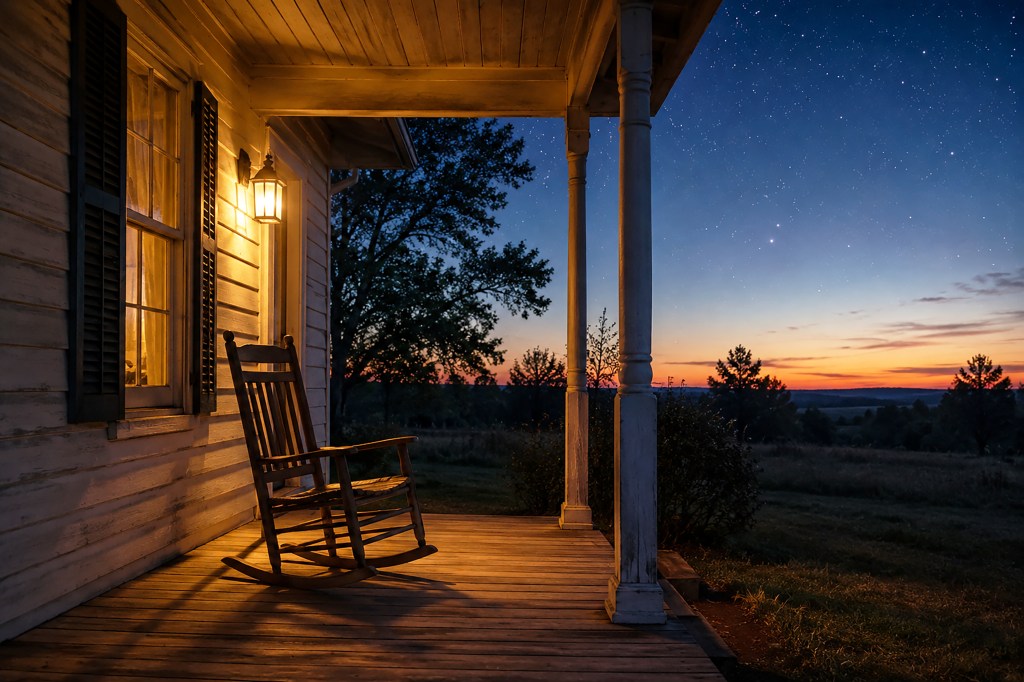
My grandmother was born in the late 1800s. She believed in the Spirit world which she introduced me to during my childhood summer stays with her. Evenings spent in rocking chairs on the front porch of her small farmhouse lasted well into the night while I listened to her life as she spoke it. She showed me how to become aware of what was present though unseen, how the hidden influenced what seemed apparent. I came to think of this moving mosaic as in-between places where surprises emerge from a variety of experiences and sources which nourish and encourage my writing. From a laughing child throwing tinsel on a Christmas tree, to seeing fear in the expectations of others, to hearing the hushed sounds of twilight’s last breath as night falls, or feeling the wind on my nine-year-old face while riding the top of a yellow pine—these and countless other flashes feed the good, bad, and in-between of life as I have lived and tried to write about it.

Much of my nonfiction and academic writing on justice issues was informed by growing up in the Deep South during the 1950s when racial injustice was commonplace, as well as time spent working with young brain-damaged boys at Central State Hospital, and as a prison psychologist in Georgia. Writing fiction and poetry has been less restrictive and more liberating, often allowing the story or poem to write me.

One of my writing quirks in that I like to have different projects going on at the same time in various stages of completion. Although I do follow a daily routine of sorts, I seem to write in spurts rather than at a set time each day. It is not uncommon for the ending of a story to come to me not far from its beginning, or the idea for phrasing a poem or piece of dialogue to come in a dream or between sleep and wakefulness. At some point in my writing, a kind of internal prompt occurs which spurs me on until a rough draft is finished.

In the end, I always ponder this question. Do I create a story or simply serve as a conduit for a story to be told through me? I suppose I believe imagination and creativity grow in the dark and in-between places, and what emerges is a kind of compassionate cooperation between story and author.

Writing 101, by Ralph Bland

Years ago, when I first began to write seriously, my plan was to always connect Point One to Point Two in some sort of scientific method, hoping to proceed that way toward a happy fulfillment. I envisioned the process being completed in a prearranged way with an outline and notes to help me along, but there always came a moment when I suddenly sat back and said “Whoa!” This was the time when I discovered that my protagonist was acting funny and had stepped outside his planned activities and my mapped-out plot had gone in strange, different directions. All at once my storyline was not anywhere near the place I’d envisioned it to be, and I’d find I didn’t know what kind of book I was writing anymore. What started out as a smooth process now had detours and sinkholes that caused my stories to stop and swerve and run off my planned narrative highway onto the literary shoulder. On those occasions, I found myself having to pause with my plans and ask myself the disconcerting question -what do I do next?

I’ve written a slew of novels at this point in time, so I guess I shouldn’t be surprised anymore when I discover I’m not really in charge of my project anymore. It always seems to be a case of the components of the manuscript stepping up to the fore and announcing they are taking over. I’m forced to throw away my previous conceptions and find a seat in the audience and let the characters and the plot and the style join together as a team and do what needs to be done to move the process along. All the stuff that was originally in my head doesn’t get totally discarded, but is used in this new approach as filler and launching pads for what is being revealed to me each writing session. It’s amazing what characters step to the fore and how the narrative proceeds when I simply get out of the way and let things flow naturally.

This is not to say that once the auto-pilot mode takes over that everything then becomes smooth and peachy. Oh no. There are still moments when the plot or the characters freeze and stumble and lose their way, and that is the time I arise from my desk and go take a walk and let the whole shebang take a breather. I and my stumbling manuscript jointly kick back and stew in our own juices a while. And usually when I return to my desk, there are fresh ideas and new avenues waiting there for me to consider. I simply practice the art of stillness for a time and allow my muse to interact with the world living in my manuscript. I find if I don’t get so anxious and give all the elements time to breathe, the right scenarios soon appear and the wagons get rolling again.

It’s entertaining sometimes to go back and study my old notes and initial outlines after a manuscript has been completed and take notice of how much my plans changed or did a complete about-face or disappeared in their entirety. More times than not, the initial sketchings and the finished product don’t resemble each other much at all, and from what I’ve learned over the years, the end result is generally much better than what my feeble brain conjectured in the first place.

My technique is never going to end up in the Writer’s Holy Grail Handbook on how to create and be successful. All I know is that somewhere along the way I learned how to get out of my own way and trust that the plates and dishes I’d been juggling would eventually find their place in the manuscript without shattering into pieces. Instead of forcing new truths onto the page or inventing narratives that don’t belong, I’ve learned to let the story settle into its own shape and reveal what it’s been trying to say all along. I’ve learned one can spoil the dinner if the broth gets added to and stirred too awfully much.

My process for writing then is to take some time to allow the words to simmer. Take a break and let the planet take a few spins. The possibility exists that upon your return you might find there’s been some blending going on and your words have become part of a nice stew. You can start writing again and the chances are you’ll be able to see down the road much more clearly without the jumble of wasted paragraphs fogging your vision. Maybe your headlights have illuminated the destination or maybe it’s just the clouds have lifted and you’re able to see what was there all the time. Sometimes a little patience goes a long way. Sometimes all one needs is some distance from the manuscript for a time, a change of perspective, a deep breath before moving forward. Think of it as a poolside break before climbing the ladder and going off the high dive again.

Tupam’s Reckoning

1759, Mission San Antonio de Valero, Province of Tejas, Viceroyalty of New Spain

Near dawn, Tupam was already carrying heavy limestone blocks. They pressed into his forearms, scraping skin hardened by months of labor. Chilly air drifted over the river his people called Yanaguana, settling over the mission compound where shadows clung to unfinished walls and wooden scaffolds. The Franciscan priests called this God’s work, but Tupam wondered why their god sought beauty in buildings instead of the sacred earth surrounding them.

He was seventeen years old, lean and sun-browned from a life spent outdoors. A year earlier he had walked the open land beside his father, Keta, following traditional deer trails. He had learned where fish gathered beneath river bends. He had slept beneath stars instead of roofs. Now bells ruled his days. Bells for prayer, for labor, for meals, and for sleep. And as the mission walls climbed higher, he felt his people’s world growing smaller.

The promise of food and security within the compound had seemed beneficial at first, even to Tupam’s family. Like many of his band, the Payaya, they had accepted the terms because of their fear of raiding Apaches from the north. But then came the coercive pressure to be baptized, coupled with increasing restrictions. Some realized their mistake and attempted to flee, but were tracked down and punished by soldiers from the presidio.

“Tupam,” came a voice from behind him. He turned to find Father Ignacio approaching through the early morning light. The priest was young, but age lines already framed his eyes. He moved quietly, his sandals brushing dust from the packed dirt.

“You should be wearing gloves,” Ignacio said in Tupam’s dialect, his Spanish accent thick.

“I have none,” Tupam replied.

The priest hesitated. “I will see what I can do.”

Tupam nodded and turned back to his task. Father Ignacio treated him kindlier than most, teaching him from translated catechisms, first in his own language, then in Spanish. Tupam learned quickly, and before long the priest was bringing him lessons that few others received. Ignacio often returned to the same passages spoken by his god named Jesus. Love your enemies. Do good to those who hate you. Blessed are the peacemakers. The words sounded noble enough, but Tupam couldn’t understand why men who employed soldiers seemed so intent on teaching them.

Near midday, Tupam found his father, Keta, carrying timber, his shoulders straining from the weight.

“You lift too much,” Tupam said. “We all lift too much.”

His father glanced toward the unfinished church. “They build walls around our bodies first,” he said quietly. “Then around our minds.”

Tupam lowered his gaze. His father spoke like this more often now, especially at night when the bells stopped ringing and shadows hid dangerous thoughts.

___

The diseases carried by the Spaniards came first. Tupam’s younger sister, Sani, survived the fever, but others didn’t. Ten children died within a single moon. An elder who had once remembered every hunting trail was gone, as was a woman who carried the old songs in her memory. Death moved quietly through the mission, taking without warning or mercy. The priests prayed over the sick as though grief could simply be folded into their daily routine.

While he worked under the sun, Tupam often thought of fishing beside his grandfather beneath the open sky. He recalled listening to stories rise with the firelight at night, the smell of mesquite smoke drifting through their camp. Their life had not been easy, but they had enjoyed a freedom so ordinary that no one had given it a name. Now Spanish cattle trampled the old gathering grounds. Children answered to Christian names, and their traditional language was more fragmented with each passing day. Tupam even heard himself thinking in Spanish sometimes, which frightened him more than anything else.

One evening, Father Ignacio paused while teaching Tupam in an unfinished wing of the mission.

“You are reading better every day. You learn so quickly.”

Tupam looked up from the rag paper page in his hands. “I still wonder why you teach us all this.”     

“Because knowledge brings power, and it should belong to everyone.”

A humorless smile touched Tupam’s face.

“My people had power before the soldiers came.”

Ignacio hesitated.

Tupam met his eyes. “Now we need permission to leave. Permission to hunt. Permission to live as we always have.” He held up the catechism. “Will these words give that back to us?”

The priest’s gaze drifted toward the unfinished walls beyond the doorway. “Knowledge is still a kind of power,” he said at last, but the words sounded rehearsed.

Tupam studied him. “Even for us?”

Something flickered across Ignacio’s face.

“Especially for you.”

Did Ignacio believe his own words? wondered Tupam. He felt conflicting emotions about the priest. Cruel men were easy to understand. They could be hated openly and resisted clearly. But men who saw the suffering around them and still convinced themselves it served a greater good were harder to fathom. Tupam sensed a genuine struggle within Ignacio, but it changed nothing.

___

Weeks passed and summer settled over the mission, pressing heat into limestone and bare skin. One afternoon, an older worker named Tecan refused to continue laboring. His hands bled openly, and exhaustion bent his body so badly he could barely remain standing. A soldier crossed the distance without hesitation and struck him hard enough to send him collapsing into the dust.

No one moved—not the workers, not Tupam, not even Father Ignacio. The priest simply turned back to his work, and as he did, something inside Tupam snapped. He clearly remembered another lesson from the catechism. If someone strikes you on one cheek, turn to him the other also. Did the command only apply to people like Tecan? he wondered. No one asked the priests or the soldiers to obey it. Tupam also recalled the Romans mocking Jesus before his death. Father Ignacio had spoken of their cruelty with obvious sorrow, yet he showed no remorse today as the soldier struck Tecan.

Anger stirred inside him and for a moment he imagined what it would feel like if fear changed sides.

That night he lay awake listening to the wind pass through unfinished beams overhead. Beside him, Sani coughed softly in her sleep while his father stared upward into the sky with its billions of stars.

“You cannot sleep?” Tupam whispered.

“No.”

“Because of Tecan?”

“No.”

Silence stretched between them.

Then his father spoke quietly. “I dreamed of your grandfather.”

Tupam waited.

“He asked me why I stay.”

The darkness seemed to grow heavier around them.

“Why do we stay?” Tupam whispered.

His father didn’t answer.

___

Two days later, Keta disappeared. There had been no farewell, only an absence his family felt immediately.

“His spirit was already gone,” his mother said with sad resignation. “Now the rest of him has followed. Let us hope they never find his tracks.”

A group of soldiers rode out before dawn the next morning. One day passed, then another, and Tupam’s family dared to believe that Keta had truly escaped. Perhaps freedom still existed somewhere beyond the stone walls.

Then, on the third day, the soldiers returned, Keta walking beside them with his hands bound and a bruise darkening one side of his face. He had not been beaten badly, which almost made it worse. What they brought back to the mission was something quieter and far more devastating than violence. It was humiliation, a lesson meant for everyone who was watching.

Workers gathered silently as a soldier cut the bindings from Keta’s wrists.

“Try again,” said the soldier in Spanish, “and we will bring you back. We will always bring you back.” Though many of the workers didn’t understand the Spaniard’s words, his meaning was unmistakable.

That night, Tupam sat beside his father in the darkness of their sleeping quarters. For a long time neither of them spoke.

Finally Tupam asked, “How far did you go?”

Keta was silent before replying. “Far enough that I could no longer hear the bells. Far enough to sleep beneath the stars and wake to the sound of nothing but the wind.” His gaze drifted toward the darkness outside the door. “I wanted to remember who I was before these walls. Before their prayers. Before they made us seek permission to walk the land that has always been ours.”

The words settled heavily between them.

Keta turned toward his son, and Tupam saw the hopelessness in his father’s eyes.

“And I thought about you,” Keta said quietly, “I began to think that you belong more to this place than to our people.”

The words struck Tupam harder than the butt of a soldier’s rifle.

___

As autumn settled over the land, sections of the mission neared completion. Tupam spent his days laboring and his evenings bent over the lessons that Father Ignacio placed before him. Reading was no longer a struggle. The words now flowed with a familiarity that would have astonished him only months earlier.

He became more familiar with each episode in Jesus’s life—his arrest, his humiliation, and his execution. In the contempt of the soldiers, the silence of those who stood by, and the punishment of an innocent man, he recognized the world he had come to know within the mission compound.

One afternoon, Father Ignacio found him sitting alone on a stone wall, taking a break from the work.

“You missed your lesson last night.”

Tupam shrugged. “I was tired from all this work.”

“We all work.”

A bitter laugh nearly escaped Tupam. “But we don’t all work the same.”

Father Ignacio sat beside him as the afternoon wind stirred grass in the courtyard. “It seems you’ve been hearing something in the lessons that I never intended to teach.”

Tupam nearly laughed in the priest’s face, choking back his anger. “No, I’ve been hearing exactly what the lessons teach. And I see how those who run this place fail to live by them.”

Ignacio’s expression hardened. “You see walls. I see children who survived the winter. I see protection from your enemies.”

Tupam watched a line of laborers carrying stone across the yard. “You speak of salvation. What if we do not wish to be saved?”

The priest was silent for a beat. “Your people came here because they were hungry and afraid. Do not pretend there was no suffering before we arrived.”

Stunned by Ignacio’s arrogance, Tupam nodded toward the workers. “My uncle died carrying those stones.”

Ignacio’s expression hardened even further. “I know.”

“And our children speak your language now.” Tupam looked down at his hands. “Some can’t even remember the old stories.”

“I know what has been lost,” said Ignacio, “but I also know what has been gained.”

Tupam could barely control his anger. He knew that if he unleashed it, the soldiers would quickly be upon him. Through clenched lips, he said, “You taught me that blessed are the peacemakers. Then why do soldiers guard your peace with rifles?”

The priest’s shoulders sagged a bit and he looked away. For a while, neither of them spoke as dust drifted through shafts of sunlight between the unfinished walls.

Finally Ignacio said, “I have seen faith transform lives.”

Tupam thought of his father, of the desperation that had driven him to flee.

“Has it transformed this place?”

Ignacio didn’t answer.

Tupam thought of the stories he had been reading. “Those men who condemned Jesus, did they believe they were doing wrong?”

The priest looked at him sharply.

“No.”

“Then they were certain, too.”

Ignacio looked away.

“I am trying not to hate you, Father.”

The priest turned back to meet Tupam’s eyes. “I know.”

“But I believe your Jesus would hate this place.”

The sudden sadness in Ignacio’s eyes was something Tupam would never forget.

___

Winter crept in by degrees. Mist rose from the river each morning, lingering a bit longer as the days grew colder.

One evening, Tupam wandered beyond the mission’s boundaries—not so far to cause an alarm, but enough to breathe freely. His mother found him there, and together they watched the sun settle beyond the trees, painting the sky orange as darkness slowly crept along the river’s edge.

“Some of the children asked me about life before the mission today,” she said softly.

“What did you tell them?”

She was quiet for a bit. “Very little.”

He frowned. “Why?”

“Because they listened as if they might someday enjoy that life for themselves.”

The words hung between them.

“And they won’t?” Tupam said, but it was more a statement of fact than a question.

Sadness touched her face. “I cannot predict the future. But I am tired of filling children’s minds with hopes that this place has taken away.”

He thought of his mother’s words as he tried to sleep that night. This loss they all felt was wearing them away. The smoldering anger that had been building inside him was now a bed of coals that refused to cool.

___

One night he found an old bundle hidden beneath blankets near his family’s sleeping mats. Inside was his grandfather’s stone knife, its surface worn smooth by years of use. The moment his hand closed around it, something hardened inside him. It wasn’t hatred toward the soldiers. Soldiers were simply obeying orders. But Father Ignacio was different. The priest had taught him to recognize injustice when he saw it. He had placed the story of an innocent man condemned by powerful authorities into Tupam’s hands and asked him to revere it. Then he walked each day through a mission built upon the suffering of people who were no longer free to leave. The contradiction had become unbearable for Tupam.

Long after the mission had gone quiet, he took the knife and walked alone beneath the cold moonlight toward Father Ignacio’s quarters. He passed sleeping families and unfinished scaffolding where labor would begin at dawn. Above him rose the mission, not a sanctuary but a fortress.

By the time he reached Father Ignacio’s door, he carried the weight of everything that was slipping away: hunting trails swallowed by mission fields, children speaking Spanish more easily than their own language, ceremonies no longer practiced, and elders who died before passing on what they knew.

As he stood there galvanizing his anger into action, he suddenly remembered another lesson from the catechism. Those who live by the sword will die by the sword. He had hated the words when he first heard them, wishing that the soldiers who bore arms around him would die violent deaths.

But now, he hated that the words rang true, and he imagined Jesus speaking to him personally.

Wind moved softly through the compound. Tupam looked down at the knife in his hand and thought of Jesus standing quietly before his tormentors—a man beaten, mocked, and killed by people convinced they were serving a righteous purpose.

For a long time, Tupam had wondered how such a thing could happen. Standing outside Father Ignacio’s door, he finally saw that the men who condemned Jesus had never imagined that his story was about them.

Slowly, Tupam lowered the knife.

The Yanaguana flowed through the darkness beyond the walls, and above him the stars burned cold and distant.

Perhaps, he thought, Jesus did not belong to empires or missions. Perhaps he stood instead with those forced to bear the weight of both.

The thought settled uneasily within him.

SO, YOU WANT TO BE A WRITER? – by David Clear

Mrs. Blythe’s 2nd grade class, 1962: The Magical Letters on the Wall

They were posted above the blackboard. All 26 of them, upper and lower case, neatly drawn on lined paper and large enough to see from a distance. They were designed to be a chore to learn and to copy, but to my seven-year-old eyes they seemed to radiate a light, an energy of some sort, different from everything else in the room.

When I reflect on this memory, one truth emerges—I was in love with the alphabet, with the words it could create, and with the worlds those words could fashion.

My mother bought me the World Book Encyclopedia while I was still in my single digits. I fell further in love with words, ideas, and stories. I am most thankful to my mother for encouraging me to learn how to use a typewriter and buying me one of my own. After the slow and cumbersome world of cursive writing, it was like being catapulted to the 24th century of Star Trek.

And then, when I was able to upgrade to an electric typewriter, I was officially lost forever in the So You Want to Be a Writer nebula.

I started my first novel length story at 14 years old, a mishmash of romance, adventure, Beatle’s music, and psychic phenomenon. I experimented with sci-fi and espionage scenarios but burned up the most typewriter ribbon ink and paper on classic adolescent angst journals.

I was a scribbling prospector wandering the bookstores by day and thinking, by night, that golden nuggets were rolling off my electric typewriter. Just a matter of time before the world found out about them.

“Writers are only successful after they’re dead,” my dad told me. I disagreed, of course. After all, I saw writers like Gore Vidal, Norman Mailer, Richard Bach, Erica Jong, Stephen King, and others being interviewed on nighttime talk shows, an obvious sign of success.

Nevertheless, it didn’t take me long to realize that the arduously slow task (by 21st century standards) of sending in stories on a typewritten piece of paper with a self-addressed stamped envelope, only to receive a rejection, wasn’t going to earn me any money to pursue it as a career.

To write, perchance to dream of making money at it; ay, there’s the rub.

It would be interesting (and likely depressing) if the ratio of wannabe paid writers to actual paid writers could be calculated. And when I say paid, I don’t mean utilitarian authors who write for newspapers, ad copy, or technical journals. I mean bestsellers like Jonathan Livingston Seagull, Harry Potter, the DaVinci Code, The Celestine Prophecy, or The Andromeda Strain.

Herman Melville had explosive success with his first two books, Typee and Omoo. But then, Moby Dick. The readers of his time didn’t get it. It sold only about 3700 copies in his lifetime. But the fact that it stands today as a masterpiece of American literature redeems Melville’s inner drive and vision to create something that went beyond the commercial market and challenged the consciousness of the reader. Melville, like F. Scott Fitzgerald and others, died well before their work achieved iconic status. I would suspect by then they were dispassionate about becoming earthly literary legends and were on to working on other, more universal projects.

I think the most important lesson I’ve learned about writing over sixty years is that the passion for it and practice of it is, first and foremost, its own ultimate and eternal reward. At age 92, the famous cellist Pablo Casals was asked why he still practiced. “Because I think I’m making progress.”

Being an author may seem to have greater cachet than being an HVAC repairman. Having lived in the south for many years, I can tell you honestly that the HVAC repairmen were equally, if not more, essential to my well-being than A Farewell to Arms. My interaction with the HVAC repairman is as valid and important in its own way as a reader’s interaction with what I have written. The difference, of course, is utilitarian versus personal. By sharing my inner worlds through my words, I am becoming more open to another human being than were I just the repairman who says, “well, the system is out of freon.”

But people connect and share with each other in many ways all the time. In that sense, writing is just another aspect of the nature and rules of human life: there’s much to learn, and doing it well takes regular study and practice.

At this very moment, millions of people are, like me, hovering over keyboards trying to channel what is percolating within them. Many others are “just” doing their jobs, raising their children, exercising, meditating, or traveling. All of them are drafting their stories by being. Whether in the form of a New York Times bestseller, or in a child’s eyes, I believe everyone’s story is heard, read, and felt.

So, paraphrasing Twain, it would seem the difference between being a writer and being a highly paid successful writer is the difference between lightning and a lightning bug. And who’s to say which is more rewarding?

Kurt Vonnegut wrote the following words in a letter dated November 5, 2006, addressed to students at Xavier High School in New York City. He had been approached by five students whose assignment was to write to their favorite authors. He was the only one to respond. I think his words capture the gist of what I’m saying.

“Practice any art, music, singing, dancing, acting, drawing, painting, sculpting, poetry, fiction, essays, reportage, no matter how well or badly, not to get money and fame, but to experience becoming, to find out what’s inside you, to make your soul grow” 

About the author: David Clear’s novel, Dreaming at the Speed of Sound, is available at this link. He has also had the following stories published by Story Sanctum: Cresting WaveThus Spake Alan, and The Overdue Library Book. David’s collection of short stories entitled The Role of a Lifetime: Stories of Reincarnation in the Theater of the Soul has just been released by Second Shore Publishing. Here is a downloadable PDF copy.