Writing 101, by Ralph Bland

Years ago, when I first began to write seriously, my plan was to always connect Point One to Point Two in some sort of scientific method, hoping to proceed that way toward a happy fulfillment. I envisioned the process being completed in a prearranged way with an outline and notes to help me along, but there always came a moment when I suddenly sat back and said “Whoa!” This was the time when I discovered that my protagonist was acting funny and had stepped outside his planned activities and my mapped-out plot had gone in strange, different directions. All at once my storyline was not anywhere near the place I’d envisioned it to be, and I’d find I didn’t know what kind of book I was writing anymore. What started out as a smooth process now had detours and sinkholes that caused my stories to stop and swerve and run off my planned narrative highway onto the literary shoulder. On those occasions, I found myself having to pause with my plans and ask myself the disconcerting question -what do I do next?

I’ve written a slew of novels at this point in time, so I guess I shouldn’t be surprised anymore when I discover I’m not really in charge of my project anymore. It always seems to be a case of the components of the manuscript stepping up to the fore and announcing they are taking over. I’m forced to throw away my previous conceptions and find a seat in the audience and let the characters and the plot and the style join together as a team and do what needs to be done to move the process along. All the stuff that was originally in my head doesn’t get totally discarded, but is used in this new approach as filler and launching pads for what is being revealed to me each writing session. It’s amazing what characters step to the fore and how the narrative proceeds when I simply get out of the way and let things flow naturally.

This is not to say that once the auto-pilot mode takes over that everything then becomes smooth and peachy. Oh no. There are still moments when the plot or the characters freeze and stumble and lose their way, and that is the time I arise from my desk and go take a walk and let the whole shebang take a breather. I and my stumbling manuscript jointly kick back and stew in our own juices a while. And usually when I return to my desk, there are fresh ideas and new avenues waiting there for me to consider. I simply practice the art of stillness for a time and allow my muse to interact with the world living in my manuscript. I find if I don’t get so anxious and give all the elements time to breathe, the right scenarios soon appear and the wagons get rolling again.

It’s entertaining sometimes to go back and study my old notes and initial outlines after a manuscript has been completed and take notice of how much my plans changed or did a complete about-face or disappeared in their entirety. More times than not, the initial sketchings and the finished product don’t resemble each other much at all, and from what I’ve learned over the years, the end result is generally much better than what my feeble brain conjectured in the first place.

My technique is never going to end up in the Writer’s Holy Grail Handbook on how to create and be successful. All I know is that somewhere along the way I learned how to get out of my own way and trust that the plates and dishes I’d been juggling would eventually find their place in the manuscript without shattering into pieces. Instead of forcing new truths onto the page or inventing narratives that don’t belong, I’ve learned to let the story settle into its own shape and reveal what it’s been trying to say all along. I’ve learned one can spoil the dinner if the broth gets added to and stirred too awfully much.

My process for writing then is to take some time to allow the words to simmer. Take a break and let the planet take a few spins. The possibility exists that upon your return you might find there’s been some blending going on and your words have become part of a nice stew. You can start writing again and the chances are you’ll be able to see down the road much more clearly without the jumble of wasted paragraphs fogging your vision. Maybe your headlights have illuminated the destination or maybe it’s just the clouds have lifted and you’re able to see what was there all the time. Sometimes a little patience goes a long way. Sometimes all one needs is some distance from the manuscript for a time, a change of perspective, a deep breath before moving forward. Think of it as a poolside break before climbing the ladder and going off the high dive again.

SO, YOU WANT TO BE A WRITER? – by David Clear

Mrs. Blythe’s 2nd grade class, 1962: The Magical Letters on the Wall

They were posted above the blackboard. All 26 of them, upper and lower case, neatly drawn on lined paper and large enough to see from a distance. They were designed to be a chore to learn and to copy, but to my seven-year-old eyes they seemed to radiate a light, an energy of some sort, different from everything else in the room.

When I reflect on this memory, one truth emerges—I was in love with the alphabet, with the words it could create, and with the worlds those words could fashion.

My mother bought me the World Book Encyclopedia while I was still in my single digits. I fell further in love with words, ideas, and stories. I am most thankful to my mother for encouraging me to learn how to use a typewriter and buying me one of my own. After the slow and cumbersome world of cursive writing, it was like being catapulted to the 24th century of Star Trek.

And then, when I was able to upgrade to an electric typewriter, I was officially lost forever in the So You Want to Be a Writer nebula.

I started my first novel length story at 14 years old, a mishmash of romance, adventure, Beatle’s music, and psychic phenomenon. I experimented with sci-fi and espionage scenarios but burned up the most typewriter ribbon ink and paper on classic adolescent angst journals.

I was a scribbling prospector wandering the bookstores by day and thinking, by night, that golden nuggets were rolling off my electric typewriter. Just a matter of time before the world found out about them.

“Writers are only successful after they’re dead,” my dad told me. I disagreed, of course. After all, I saw writers like Gore Vidal, Norman Mailer, Richard Bach, Erica Jong, Stephen King, and others being interviewed on nighttime talk shows, an obvious sign of success.

Nevertheless, it didn’t take me long to realize that the arduously slow task (by 21st century standards) of sending in stories on a typewritten piece of paper with a self-addressed stamped envelope, only to receive a rejection, wasn’t going to earn me any money to pursue it as a career.

To write, perchance to dream of making money at it; ay, there’s the rub.

It would be interesting (and likely depressing) if the ratio of wannabe paid writers to actual paid writers could be calculated. And when I say paid, I don’t mean utilitarian authors who write for newspapers, ad copy, or technical journals. I mean bestsellers like Jonathan Livingston Seagull, Harry Potter, the DaVinci Code, The Celestine Prophecy, or The Andromeda Strain.

Herman Melville had explosive success with his first two books, Typee and Omoo. But then, Moby Dick. The readers of his time didn’t get it. It sold only about 3700 copies in his lifetime. But the fact that it stands today as a masterpiece of American literature redeems Melville’s inner drive and vision to create something that went beyond the commercial market and challenged the consciousness of the reader. Melville, like F. Scott Fitzgerald and others, died well before their work achieved iconic status. I would suspect by then they were dispassionate about becoming earthly literary legends and were on to working on other, more universal projects.

I think the most important lesson I’ve learned about writing over sixty years is that the passion for it and practice of it is, first and foremost, its own ultimate and eternal reward. At age 92, the famous cellist Pablo Casals was asked why he still practiced. “Because I think I’m making progress.”

Being an author may seem to have greater cachet than being an HVAC repairman. Having lived in the south for many years, I can tell you honestly that the HVAC repairmen were equally, if not more, essential to my well-being than A Farewell to Arms. My interaction with the HVAC repairman is as valid and important in its own way as a reader’s interaction with what I have written. The difference, of course, is utilitarian versus personal. By sharing my inner worlds through my words, I am becoming more open to another human being than were I just the repairman who says, “well, the system is out of freon.”

But people connect and share with each other in many ways all the time. In that sense, writing is just another aspect of the nature and rules of human life: there’s much to learn, and doing it well takes regular study and practice.

At this very moment, millions of people are, like me, hovering over keyboards trying to channel what is percolating within them. Many others are “just” doing their jobs, raising their children, exercising, meditating, or traveling. All of them are drafting their stories by being. Whether in the form of a New York Times bestseller, or in a child’s eyes, I believe everyone’s story is heard, read, and felt.

So, paraphrasing Twain, it would seem the difference between being a writer and being a highly paid successful writer is the difference between lightning and a lightning bug. And who’s to say which is more rewarding?

Kurt Vonnegut wrote the following words in a letter dated November 5, 2006, addressed to students at Xavier High School in New York City. He had been approached by five students whose assignment was to write to their favorite authors. He was the only one to respond. I think his words capture the gist of what I’m saying.

“Practice any art, music, singing, dancing, acting, drawing, painting, sculpting, poetry, fiction, essays, reportage, no matter how well or badly, not to get money and fame, but to experience becoming, to find out what’s inside you, to make your soul grow” 

About the author: David Clear’s novel, Dreaming at the Speed of Sound, is available at this link. He has also had the following stories published by Story Sanctum: Cresting WaveThus Spake Alan, and The Overdue Library Book. David’s collection of short stories entitled The Role of a Lifetime: Stories of Reincarnation in the Theater of the Soul has just been released by Second Shore Publishing. Here is a downloadable PDF copy.

The Woman in 4C

No one remembered exactly when Yasmin appeared in the building, which should have been the first warning.

It was a faded, four story complex tucked into a side street of Los Angeles, where ceiling fans clicked through the heat and distant traffic hummed at all hours. Each apartment had a small balcony overlooking the courtyard with its dry grass and rusty park benches. Most of the tenants had been there for years, and certain patterns were like clockwork. Maria in 3B watered her plants at seven each morning. Darla in 1C played the same Coltrane record every evening after dinner. Daniel returned from his nightshift, slamming his door too early in the wee hours. The landlord, Mr. Alvarez, collected rent on the first Monday of the month, never making direct eye contact.

Then one day, without ceremony, apartment 4C was no longer empty. There had been no moving truck and no hauling of furniture up the exterior stairwell. Just a name penciled onto the row of mailboxes.

Yasmin.

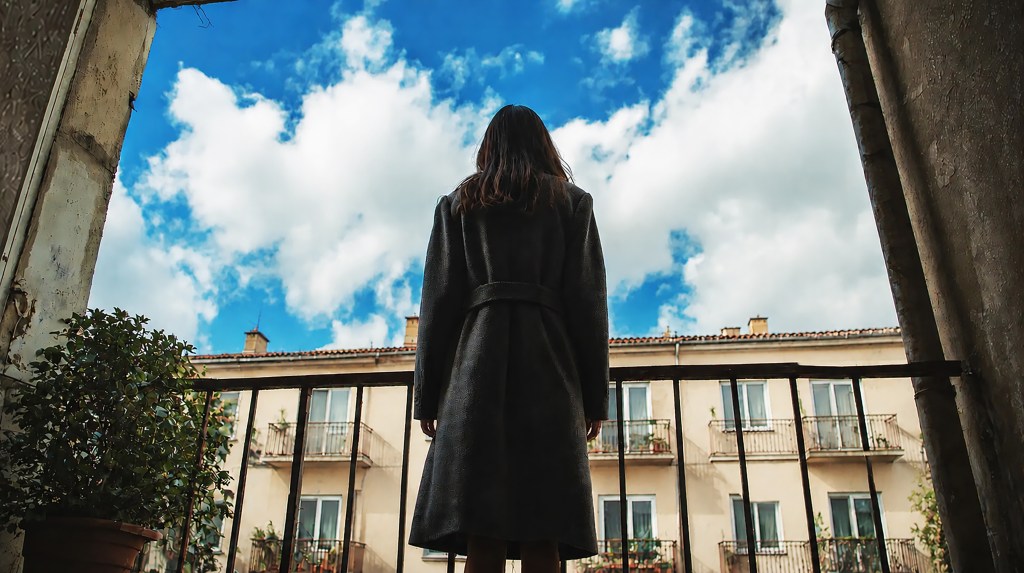
The first person to notice her was Maria. Yasmin was standing very still on the exterior staircase, late afternoon sun highlighting her long dark hair. She wore a knee-length charcoal coat despite the heat, and her pale eyes shifted over the courtyard, then the hazy L.A. sky, never settling on one thing for too long.

“Oh,” Maria said, startled into politeness. “You must be new. Did you move in recently?”

When Yasmin turned, she seemed to look through Maria, not just at her.

“I suppose I’m new,” she said, “but I’ve been here long enough.”

Her voice was neither warm nor cold, a bit unnerving.

“Well, let me welcome you,” Maria said. “We’re a close knit group of neighbors.”

“Yes, I know,” said Yasmin.

That answer stayed with Maria long after they parted.

The second person to notice her was Daniel in 3B, though he didn’t realize it until later. A struggling screenwriter by day, he worked swing shifts for UPS, sleeping late and awakening around noon to confront his persistent writer’s block. One day, after a cup of strong coffee, he noticed minute details out of place in his apartment: a book shifted slightly on a shelf, a chair angled a few degrees differently, his notebook open to a page he didn’t recall writing. It wasn’t enough to report a break in; the police would think he was batty.

He told himself he was only tired, but then he read the line in the notebook. It was undeniably his handwriting.

“You keep treating the future like a possibility instead of a memory.”

Daniel stared at the sentence for a long time. Not only was he sure he hadn’t written it; he couldn’t even remember thinking it. And its meaning was so cryptic that he couldn’t wrap his mind around it.

That same evening, he came upon Yasmin for the first time. They were in the courtyard near the mailboxes, where Yasmin flipped slowly through a stack of letters. She was still wearing her charcoal coat, and Daniel wondered how someone who had recently arrived could receive so much mail.

“You’re new here?” Daniel asked, trying to sound casual.

Yasmin swung her gaze to him.

“By some definitions of new,” she said.

Daniel frowned a bit. “Right.”

They stood there a beat too long, staring at each other. Daniel was intrigued by Yasmin’s pale eyes.

“You write,” Yasmin said, breaking the silence.

It wasn’t a question.

Daniel blinked as a slight chill ran up his spine. “I try.”

“You doubt yourself,” she said. “That’s the part that always slows you down.”

Daniel felt a flicker of irritation. “Do I know you?”

Yasmin considered that, as if weighing her answer.

“Not yet,” she said.

Then she slipped past him and ascended the exterior stairs, leaving him with a feeling he could only describe as queasy

By the end of the week, everyone in the building had a story. The college student in 4D swore that Yasmin quoted a line from her private journal. A struggling actor on the second floor insisted that Yasmin quietly muttered lines from an audition scene he had only practiced alone. An older woman near the back stairwell said Yasmin asked her whether she planned to visit her son in Sacramento again, even though she’d told no one of their estrangement. Mr. Alvarez insisted he had no record of a lease for 4C, though he remembered collecting rent from someone. One tenant claimed that Yasmin congratulated him on a promotion before he even applied for the position. Another said she passed Yasmin in the hallway and heard her softly humming a song played at her husband’s funeral twenty years earlier. The young couple in 1A had been arguing in the hallway when Yasmin passed them and casually remarked, “You already know which one of you leaves first.”

The stories overlapped in an unsettling way that was clear to all of them. Yasmin seemed to know things she shouldn’t, and she never seemed surprised.

Maria tried to ignore it. She had lived in the building long enough to understand that people were strange in their own ways. But one morning, as she watered her plants, she noticed something that made her pause. Across the courtyard, through the window of 4C, she saw Yasmin sitting at a desk. A pen rested in her hand, and she was working on something. That wasn’t strange by itself. What was unusual was Yasmin’s rhythm. She would jot down a few lines, pause, then look up as if listening to some source Maria couldn’t see. Then she would nod, put down a few more words, and repeat the pattern.

Maria had always been bold to the point of meddling, a trait that had gotten her into trouble over the years. The next morning, she decided to visit Yasmin and get to the bottom of things.

She knocked on the door of 4C and it opened immediately. “Yes?” Yasmin said.

Maria hesitated. “I hope I’m not bothering you. I just wanted to ask you something.”

“Of course,” Yasmin said.

Maria glanced past her with no attempt to hide her nosiness. The studio apartment was sparsely furnished with a desk, a chair, and a bed. No unpacked boxes or signs of settling in.

“What do you do?”

Yasmin tilted her head slightly, her lips curling as if she was slightly amused.

“I pay attention,” she said.

“That’s not really an answer.”

“It is the only one that matters.”

Maria crossed her arms. “People are saying things about you.”

“I’m not surprised. They usually do.”

“That you know things,” Maria pressed on. “Private things you shouldn’t. Things you would have no way of knowing.”

Yasmin studied her for a few seconds, then stepped aside.

“Would you like to come in?” she asked.

Maria should have said no. Instead, she crossed the threshold. The air in the apartment was still, and on the desk was the open notebook she had seen through the window. Maria’s eyes fixed on it longer than she intended.

“Go ahead and read it,” said Yasmin with her cool, neutral tone.

Maria hesitated. “That feels invasive.”

“It’s only invasive if it’s not already yours,” Yasmin said.

Something about that answer unsettled Maria more than if Yasmin had simply refused. Slowly, she approached the desk. The open page was filled with neat, deliberate handwriting, and as she started to read, her breath caught. The words were about her. Not just vague or general observations, but specific details. The way she counted steps without realizing it. The way she avoided calling her sister because she didn’t want to admit how distant they had become. The way she watered her plants at seven each morning because it gave her a small sense of control. The way she sometimes replayed old conversations in the shower, changing what she should have said years earlier.

Maria stepped back, feeling a mix of curiosity and anger.

“How do you know this?” she demanded.

Yasmin didn’t move.

“You told me,” she said.

“No, I didn’t.”

“Not in words.”

“That doesn’t make sense.”

“It does,” Yasmin said gently, “if you have the right way of observing.”

Maria shook her head. “This isn’t normal.”

“No,” Yasmin agreed. “Unfortunately, it isn’t.”

Maria shook her head, growing angrier by the second. “But why are you writing about us?”

Yasmin looked at the notebook for a long moment before answering.

“Because people reveal themselves long before they understand what they’re doing,” she said quietly. “Because they rarely notice the full spectrum, just like they can’t see the full spectrum of light.”

Maria frowned with anger “What the hell does that mean?”

Yasmin’s eyes bore into hers.

“It means most people only register one surface of things.”

“And you’re somehow able to recognize all this?”

Yasmin sighed as if she was burdened.

“I’m just catching up,” she said.

___

Maria was the primary gossip in the building, so she quickly told the other residents what had happened in Yasmin’s apartment. That was the exact moment that fear began to take root. It spread quietly at first. A shared glance in the hallway, a conversation cut short when Yasmin came near, and doors that closed more quickly.

Other things happened as well.

Daniel started writing again, feeling a compulsion he hadn’t known for years. The sentences came faster, sharper, and more precise, flowing as if an internal dam had busted. One night, he wrote a line that made his hands go still on his keyboard.

“She sees people the way we usually see memories and unfinished thoughts.”

Daniel stared at the words.

Then he heard slow and measured footsteps outside his door. He got up and cautiously opened it to find Yasmin standing there. He wasn’t surprised.

“You’re getting closer,” she said.

“To what?”

Her expression was almost sympathetic. “To the part where your plot lines stop feeling like coincidence.”

Daniel swallowed. “Who are you, really? Or should I ask, what are you?”

Yasmin considered the question. “Someone who stopped pretending moments arrive one at a time.”

“That’s not an answer.”

“It is the only one that will make sense later.”

Like Maria, Daniel felt a surge of frustration and anger. “Later when?”

Yasmin met his eyes.

“Soon,” she said, then walked away.

___

People had trouble sleeping. The building seemed claustrophobic, as if the walls had shifted slightly inward. Maria lay awake, staring at the ceiling, replaying the words she had read in Yasmin’s notebook. She couldn’t shake the feeling that something had already been decided and that she was moving through moments that had been written long before she ever reached them.

In his apartment, Daniel sat at his desk, staring at a blank screen. He knew what he was supposed to write. He didn’t want to, but his hands moved across the keyboard anyway to form a short sentence.

“She never seemed surprised.”

At that instant, sounds erupted through the building: doors, footsteps, and echoing voices. One by one, all the tenants felt the need to exit their apartments and gather in the courtyard, compelled by a something they couldn’t name. Daniel got up for the same reason and joined them.

They looked at each other in the wan light, uncertain what was happening. Then they looked up. The sliding glass door to the balcony of 4C was open, its drapes blowing even though there was no wind.

 Daniel glanced around the circle of onlookers. “What the fuck? Maria and I will go up and check to see if Yasmin’s okay. We’ll be right back.”

Maria needed no further prodding. She and Daniel quickly ascended the exterior stairwell, entered the hallway on the fourth floor, and proceed to 4C. The door was open so they stepped inside.

“Yasmin!” called Daniel. No answer. The apartment was empty, but the desk was still there with Yasmin’s open notebook on top.

Daniel approached it hesitantly, then he looked down and read the words aloud.

“The moment you realize you were never standing outside it is the moment you begin writing the story that matters most.”

Maria stepped closer. “What the hell does that mean?”

Daniel turned the page as his face went pale.

“What?” Maria asked. “Tell me.”

He swallowed. “There’s no more. Just blank pages.”

A faint breeze moved through the room through the open sliding glass door.

___

The next day, apartment 4C was empty again. No name on the mailbox. No record with Mr. Alvarez. Not a trace.

The tenants tried to move on, acting as if the whole interlude with Yasmin had been some kind of collective hallucination. The routines of the building resumed. Maria watered her plants at seven. Darla bopped to Coltrane after dinner. The actor rehearsed in front of his mirror. Mr. Alvarez collected rent with his usual stiff silence.

But the familiar patterns no longer felt unconscious.

People hesitated before speaking, as if listening for words before choosing them. Several tenants began anticipating knocks on their doors before they occurred. Others found themselves thinking of people they hadn’t spoken to in years, only for the phone to ring hours later. A woman on the third floor burst into tears; she had smelled her late mother’s perfume in the laundry room just moments before she learned that her childhood home had been sold. The actor began having strange intuitions during conversations where he already knew the next sentence the other person was about to say, along with the exact expression that would cross their face. A young mother on the first floor began setting an extra plate at dinner without understanding why, only to receive unexpected visits from relatives later that evening.

Daniel kept writing, a story about an apartment building filled with a diverse cast of characters and a stranger that came into their midst. He changed the names and altered circumstances, but it was all there. His writing continued to flow freely, unnervingly precise, and he told himself that Yasmin had merely shaken something loose creatively.

One evening he froze after typing a particular sentence that seemed to come from nowhere. “Maria stood at her kitchen sink for almost ten minutes, rehearsing her first sentence before she finally called her sister at 9:14 p.m.”

Daniel stared at the screen.

That night, shortly after 9:00 p.m., he quietly watched Maria’s apartment through a gap in his curtains. Her shades were open, so he could see her clearly. At 9:04 p.m., she stood at her kitchen counter, and ten minutes later she slowly lifted her phone.

Daniel backed away from the window as though burned.

___

No one spoke openly about Yasmin anymore. That was the strangest part. It was as though they had a silent pact to never name what had happened.

Weeks later, Daniel felt the urge to return to 4C. It was still vacant, so he asked Mr. Alvarez for permission, using the subterfuge that he wanted to take pictures for a friend who needed new lodging. Mr. Alvarez shrugged and gave him the key.

Inside, dust had coated the bare floor and the air smelled musty. The room was silent except for that distant traffic hum that seemed to penetrate the entire building. He stood there for a long time before noticing something propped against the sliding glass door on the balcony outside.

A notebook. His stomach tightened because it wasn’t Yasmin’s, it was his.

He opened the door and picked it up. Inside, once again, was a sentence in his handwriting that he had never seen before.

“She was never staying here. She was just teaching you how to see.”

He flipped through the rest of the notebook. It was blank except for a final line waiting on the very last page. It read: “You were noticing long before you understood what you were seeing.”

Daniel slowly lowered the notebook. Across the courtyard, lights glowed behind apartment windows, and for one strange instant the entire building felt conscious of itself.

Then, somewhere in the courtyard four floors beneath him, he heard a woman’s voice drift upwards.

“You must be new here.”

Silent Scream at Four Corners

(Periodically, I will post reviews and comments about excellent writers I’ve met over the years.)

I’m a big fan of John RC Potter’s writing, so I was excited to open his recent novella, The General Store at Four Corners. It’s one of three pieces featured in Body Lines, a new journal published by Subtle Body Press.

I was not disappointed!

This is a tale of lust, betrayal, and violence set in the small fictional village of Four Corners, Ontario. Its timeframe jumps back and forth through a 20-year period between 1914 and 1934, but the transitions are never jarring. Potter weaves each episode into the narrative seamlessly. As usual, his eye for locale is superb. The General Store at the heart of the story, the surrounding farms, and the annual carnival all come vividly to life against a backdrop of historical events from that era.

But the real strength of this story is its cast of colorful characters. Among them are:

  • Jewel Cotton, raising her brood of children in hardscrabble poverty while enduring the violence of her alcoholic husband.
  • Hilda Judges, with her smug know-it-all attitude.
  • Mr. Burnbridges, the good-natured store owner oblivious to cuckolding.
  • Al Heidler, the mysterious and virile young man who drifts into the Burnbridges’ life, setting up a fated chain of consequences.
  • Mrs. Sharp, the fortune teller whose prognostication is tragically accurate.

At the center of it all is the main character, Beulah Burnbridges. I would be lying if I said there is anything likeable about her. With a naturalistic perspective that recalls Émile Zola or Theodore Dreiser, Potter examines every painful, deterministic force that shapes Beulah’s life. The violence of her nuclear family, her lust, her use of sex as a tool to achieve her limited social climbing—all these get examined under a clinical microscope.

I don’t intend a spoiler here, but near the climax of this saga, Beulah emits a primal shriek. She thinks it is audible until she realizes she is hearing it only in her head, an anguish that emanates from all the pain and struggle stored within her soul. Think of Munch’s The Scream.

The Epilogue of this tale is chilling, even fitting, but it is Beulah’s noiseless cry that rose off the page into my ears. I won’t forget it.

John RC Potter is an international educator from Canada who lives in Istanbul.  He has experienced a revolution (Indonesia), air strikes (Israel), earthquakes (Turkey), boredom (UAE), and blinding snow blizzards (Canada), the last being the subject of his story, Snowbound in the House of God (Memoirist). His poems, stories, essays, articles, and reviews have been published in various magazines and journals. His story, Ruth’s World, was a Pushcart Prize nominee, and his poem, Tomato Heart, was nominated for the Best of the Net Award. The author’s gay-themed children’s picture book, The First Adventures of Walli and Magoo, is scheduled for publication. He enjoys duties as the editor of the online journal Masticadores Istanbul. Website: https://johnrcpotterauthor.com